Sunday, August 23, 2026 — For systems engineers building High-Frequency Trading (HFT) platforms, AAA game engines, real-time DSP pipelines, and embedded kernel drivers, eliminating memory allocation overhead and latency jitter is the ultimate performance goal.
In the C++26 standard, standard library advancements provide breakthrough capabilities for zero-overhead architecture: std::inplace_vector<T, N> (dynamic vector stored entirely on the stack), std::flat_map / std::flat_set (cache-friendly contiguous sorted containers), and Hazard Pointers (std::hazard_pointer, P2530) for lock-free safe memory reclamation.
Here is a comprehensive breakdown of how these new tools eliminate latency spikes and guarantee sub-microsecond determinism.

1. Why Dynamic Heap Allocation Destroys Low-Latency Performance
While standard containers like std::vector and std::map are convenient, calling malloc or operator new on critical paths introduces severe issues:
- Non-Deterministic Latency & Jitter: Global heap locks, virtual memory page faults, and chunk splitting cause unpredictable latency spikes exceeding hundreds of microseconds.
- L1/L2 Cache Evictions: Chasing scattered heap pointers wipes out CPU cache lines, stalling pipelines while waiting for DRAM fetches.
- Heap Fragmentation: Frequent allocations and deallocations fragment memory over long execution runs, compromising system uptime.
In performance-critical software, the golden rule is simple: Eliminate all dynamic heap allocations on hot execution paths (Zero-Allocation Architecture).
2. std::inplace_vector<T, N>: The Complete Stack-Based Vector
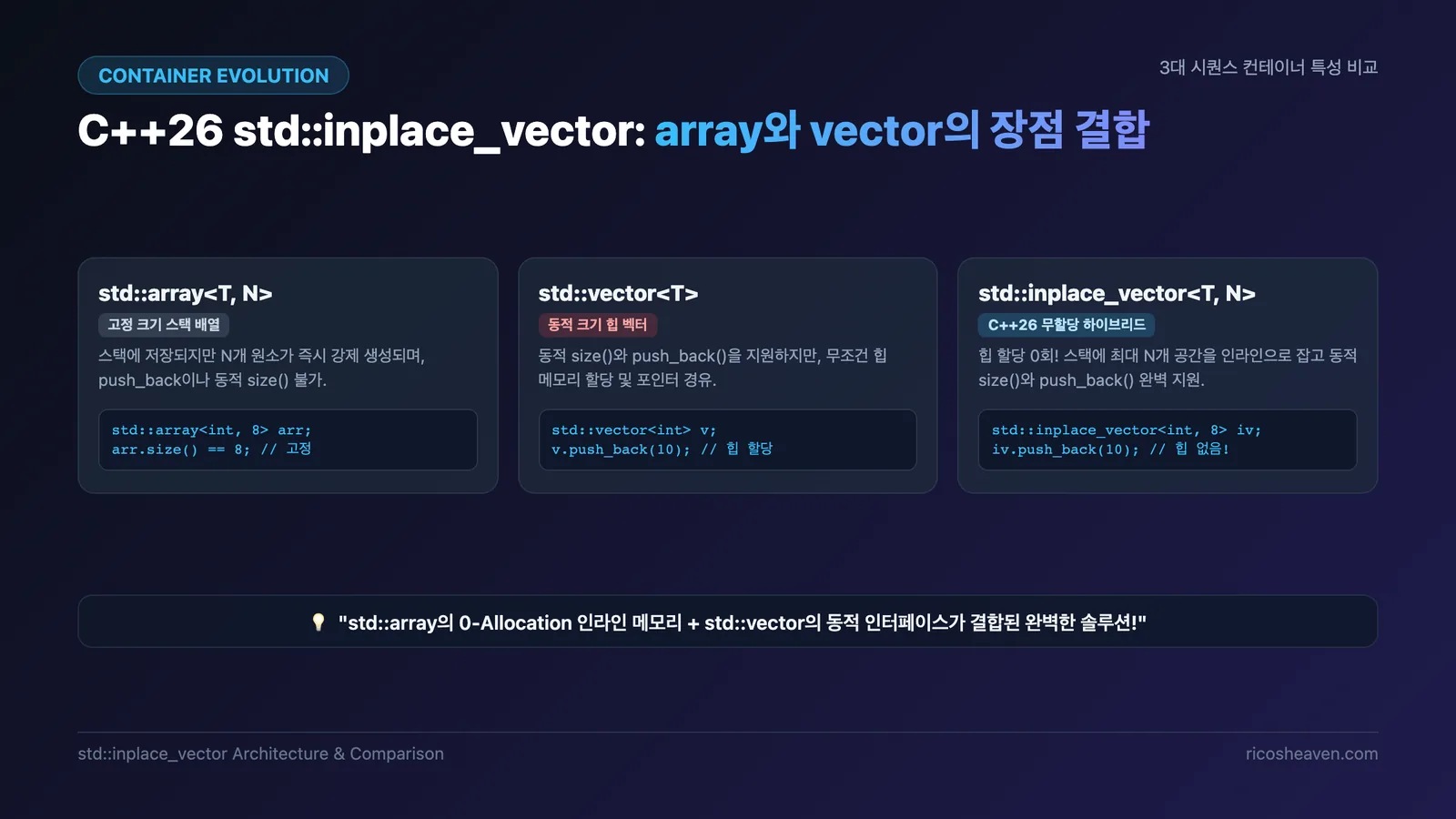
C++26's std::inplace_vector combines the inline contiguous storage of std::array with the dynamic resizing and lifetime management of std::vector.
1) Comparing the Three Sequence Containers
- std::array<T, N>: Stack-allocated, but requires eager construction of all
Nelements and lacks dynamicsize()orpush_back(). - std::vector<T>: Dynamically resizable with
push_back(), but mandates heap memory allocation. - std::inplace_vector<T, N>: Zero heap allocations. Pre-allocates buffer space for up to
Nelements in-place while dynamically tracking active elements.
2) Practical Production Example
#include <iostream>
#include <inplace_vector>

struct Order {
    int id;
    double price;
    int qty;
};

// Process up to 8 orders completely on the stack with 0 heap allocations
void process_batch_orders() {
    std::inplace_vector<Order, 8> orders; // Zero heap allocation!

    // 1. Standard push_back (throws std::bad_alloc if capacity exceeded)
    orders.push_back(Order{101, 50000.0, 10});
    orders.push_back(Order{102, 50100.0, 5});

    // 2. Exception-free environments: try_push_back (returns pointer or nullptr)
    if (auto* ptr = orders.try_push_back(Order{103, 49900.0, 20})) {
        std::cout << "Order 103 added safely!\n";
    }

    // 3. Maximum performance: unchecked_push_back (skips bounds check, UB if full)
    orders.unchecked_push_back(Order{104, 50200.0, 15});

    std::cout << "Total Orders: " << orders.size() << " / " << orders.capacity() << "\n";
}
3. Cache-Friendly Contiguous Containers: std::flat_map & std::flat_set
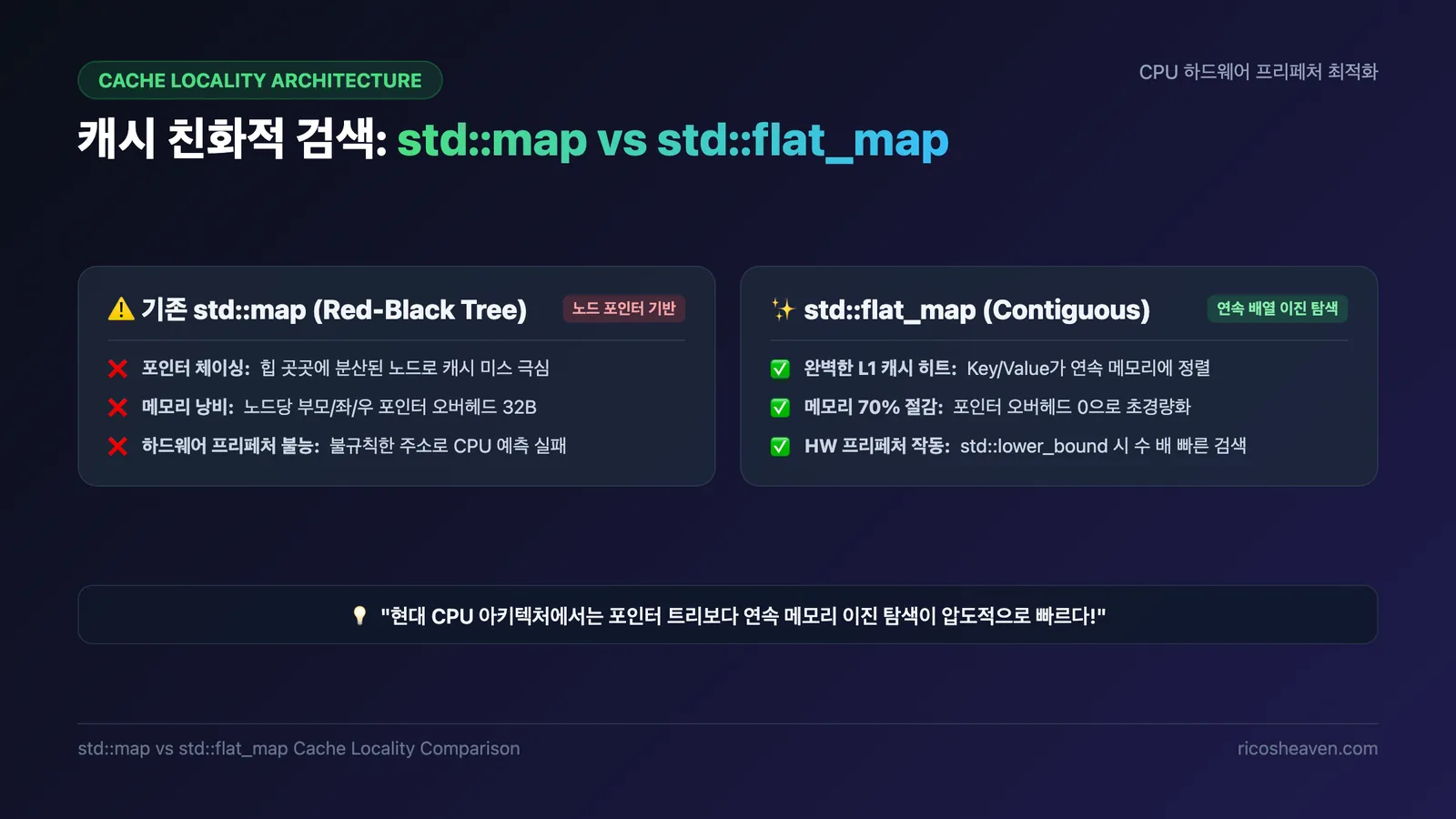
Traditional std::map and std::set use node-based Red-Black Trees. Traversing nodes forces the CPU to jump across arbitrary heap addresses (pointer chasing), constantly evicting cache lines.
How std::flat_map Works
std::flat_map stores keys and values in two contiguous sorted 1D arrays (backed by std::vector or std::inplace_vector).
- Blazing Search Speed: Because elements are packed contiguously, executing
std::lower_boundbinary searches allows the hardware CPU prefetcher to stream data directly into L1/L2 cache ahead of time. - 70%+ Memory Reduction: Eliminates per-node parent/child pointer and color tag overhead (saving 24~32 bytes per entry).
#include <iostream>
#include <flat_map>
#include <string>

int main() {
    // Cache-friendly sorted map backed by contiguous memory
    std::flat_map<int, std::string> user_table;

    user_table[101] = "Alice";
    user_table[205] = "Bob";
    user_table[150] = "Charlie"; // Automatically maintains sorted order

    // Ultra-fast binary search over contiguous cache lines
    auto it = user_table.find(150);
    if (it != user_table.end()) {
        std::cout << "Found: " << it->second << "\n";
    }
}
4. Lock-Free Safe Memory Reclamation: Hazard Pointers (P2530)
When implementing lock-free data structures (such as lock-free queues or skip lists) without mutexes using std::atomic, the hardest challenge is Safe Memory Reclamation (SMR).
1) The Lock-Free Use-After-Free Problem
- Scenario: Thread A fetches a pointer to Node
Xin a lock-free queue. Concurrently, Thread B unlinks NodeXand immediately callsdelete. - Result: Thread A attempts to read freed memory, causing crashes or silent memory corruption (Use-After-Free / ABA problem).
2) The Hazard Pointer Solution
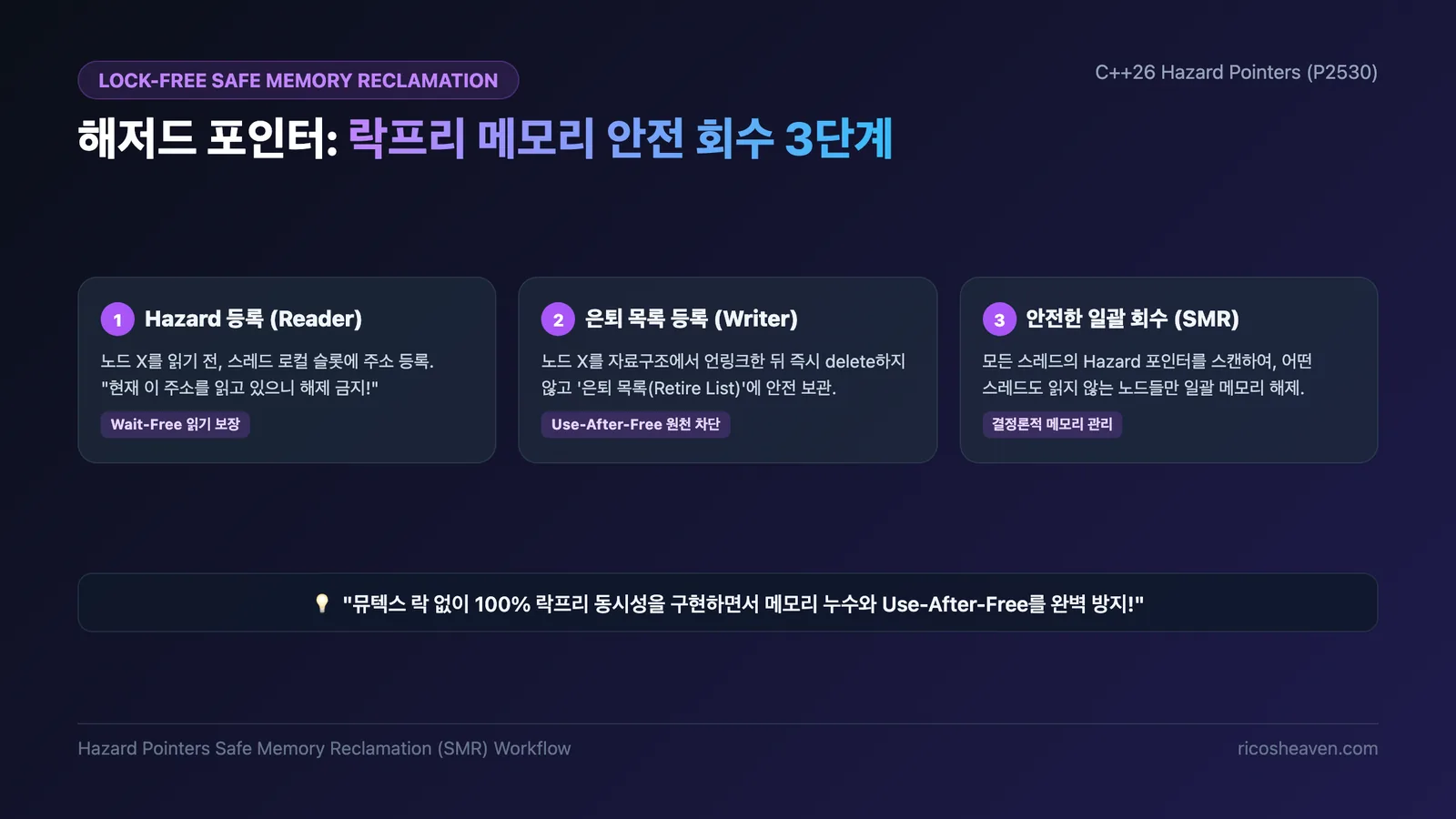
- Reader Thread (Hazard Declaration): Before accessing Node
X, the reader writesX's address into its thread-local hazard pointer slot. - Writer Thread (Retire List): When unlinking Node
X, the writer adds it to a "Retire List" rather than immediately deleting it. - Batch Reclamation (SMR): When the retire list reaches a threshold, the system scans all active hazard pointers and deletes only nodes that are no longer protected by any reader thread.
This mechanism guarantees 100% safe, wait-free read paths without locking or garbage collection pauses.
5. Engineering Conclusion: The Modern Low-Latency Toolkit
The C++26 standard library additions provide systems developers with battle-tested primitives for deterministic performance:
- std::inplace_vector: Completely removes heap allocation jitter on hot execution paths.
- std::flat_map: Maximizes hardware cache prefetching with contiguous sorted layouts.
- std::hazard_pointer: Solves lock-free memory lifecycle management with standardized safety.
For developers engineering trading systems, game backends, real-time robotics, and kernel components, adopting these zero-allocation and lock-free tools is a massive competitive advantage.