Serializing objects to disk, network packets, or JSON format in C++ has traditionally been a painful compromise. Developers were forced to inject invasive macros into domain classes or maintain external schema files (.proto, .fbs) with separate IDL compiler stages.
Standardized in C++26, Static Reflection (P2996) obsoletes these legacy workarounds, providing a unified, pure C++ compile-time serialization architecture.
This article examines the structural flaws of legacy serialization and demonstrates how to build zero-overhead JSON and binary serialization engines using C++26's ^^ reflection operator, [: :] splicer, and std::meta reflection APIs.
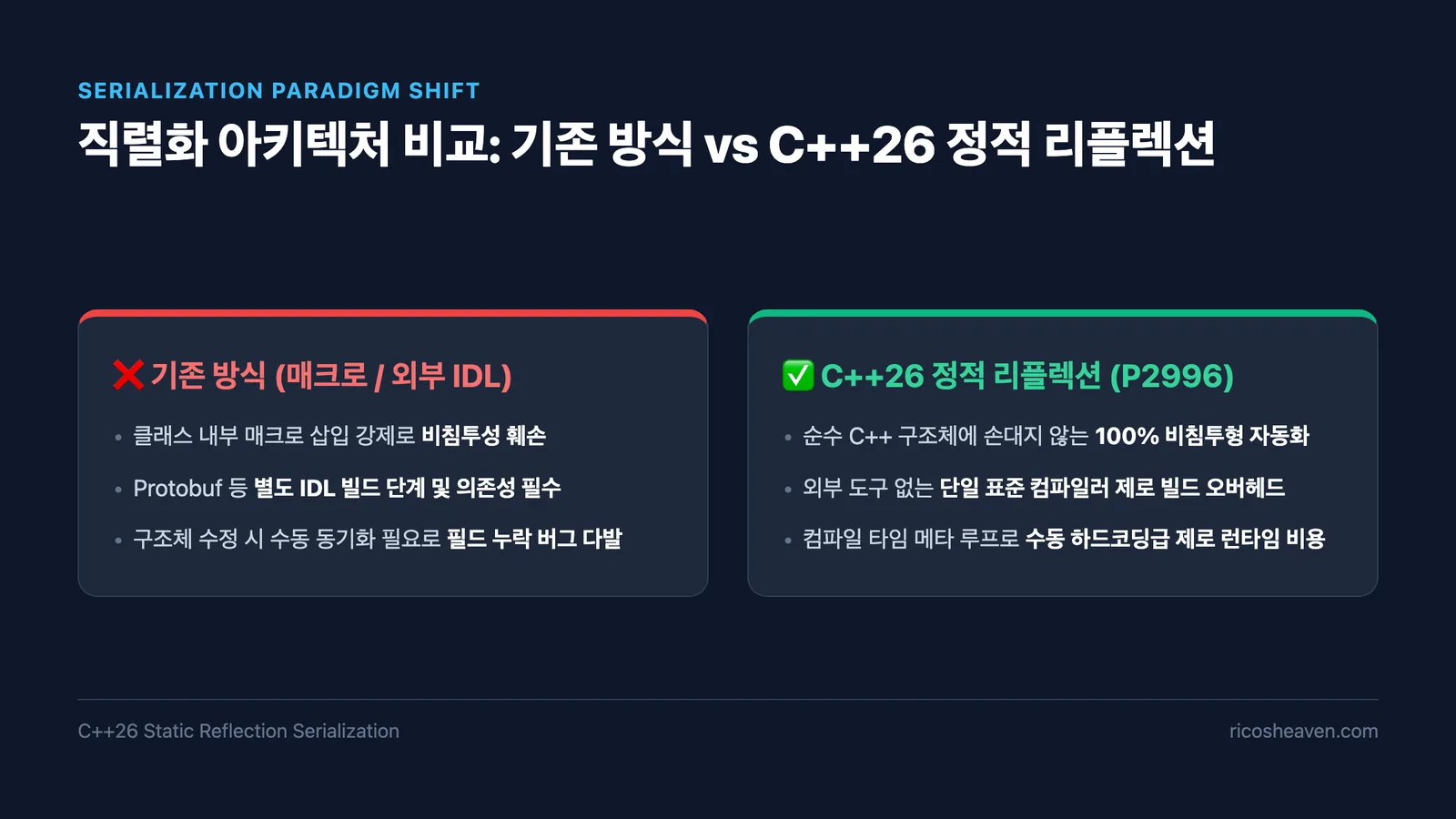
1. The Three Structural Flaws of Legacy C++ Serialization
Historically, C++ engineers had to pick between three compromised models:
- Macro-Based Intrusive Models (Boost.Serialization, cereal): Requires intrusive macros or dedicated archive methods inside class definitions. Serializing third-party library types is cumbersome, and template compiler errors frequently cascade into unreadable diagnostics.
- External IDL Compilers (Protocol Buffers, FlatBuffers): Forces schemas into dedicated DSLs (
.proto), complicating build pipelines. Generated C++ classes lack seamless compatibility with native STL containers (std::vector,std::string_view), leading to redundant data copies. - Structured Binding Hacks (Boost.PFR / Magic Get): Emulates reflection using template destructuring, but cannot inspect field names at compile time and imposes arbitrary member limits (often max 100 members) while inflating compile times.
2. The Paradigm Shift of C++26 Static Reflection (P2996)
P2996 introduces language-level introspection and code generation:
- 100% Non-Intrusive: Plain Old Structs (PODs) require zero macros, inheritance, or code annotations.
- Simultaneous Name and Type Deduction:
std::meta::name_ofextracts member names as compile-time string constants, whilestd::meta::type_ofqueries types seamlessly. - Zero Runtime Overhead: Loops unroll and inline entirely at compile time, matching the machine assembly of hand-written manual serialization code.

3. Implementation 1: Pure C++26 Generic JSON Serializer
A complete generic serializer converting arbitrary structs into valid JSON strings without macros or external dependencies:
#include <meta>
#include <string>
#include <sstream>
#include <concepts>
#include <iostream>

// Primitive serializer helper
template <typename T>
void SerializeValue(std::ostringstream& oss, const T& val) {
    if constexpr (std::same_as<T, std::string> || std::same_as<T, std::string_view>) {
        oss << '"' << val << '"';
    } else if constexpr (std::same_as<T, bool>) {
        oss << (val ? "true" : "false");
    } else {
        oss << val;
    }
}

// C++26 reflection-based generic JSON serializer
template <typename T>
requires std::is_aggregate_v<T>
std::string ToJson(const T& obj) {
    std::ostringstream oss;
    oss << "{";

    bool first = true;

    // Iterate over all non-static data members at compile time
    template for (constexpr auto member : std::meta::nonstatic_data_members_of(^^T)) {
        if (!first) {
            oss << ",";
        }
        first = false;

        // 1. Extract member field name at compile time
        constexpr auto fieldName = std::meta::name_of(member);
        oss << '"' << fieldName << "\":";

        // 2. Splice member access directly onto the object instance
        SerializeValue(oss, obj.[:member:]);
    }

    oss << "}";
    return oss.str();
}

// Domain data model (Pure C++ struct)
struct OrderRequest {
    uint64_t    orderId;
    std::string accountNo;
    std::string symbol;
    double      price;
    uint32_t    quantity;
    bool        isBuy;
};

int main() {
    OrderRequest req{
        .orderId   = 20260828001,
        .accountNo = "5401-229-11",
        .symbol    = "005930",
        .price     = 78500.0,
        .quantity  = 50,
        .isBuy     = true
    };

    std::string jsonStr = ToJson(req);
    std::cout << jsonStr << std::endl;
}
4. Implementation 2: High-Throughput Binary Packet Serializer
In trading gateways and distributed nodes, raw byte packing outperforms text serialization:
#include <meta>
#include <vector>
#include <cstring>
#include <iostream>

class BinaryPacketWriter {
private:
    std::vector<uint8_t> m_buffer;

public:
    template <typename T>
    void Write(const T& val) {
        if constexpr (std::is_fundamental_v<T> || std::is_enum_v<T>) {
            // Direct memory copy into packet buffer (Zero-overhead)
            const auto* bytePtr = reinterpret_cast<const uint8_t*>(&val);
            m_buffer.insert(m_buffer.end(), bytePtr, bytePtr + sizeof(T));
        } else if constexpr (std::same_as<T, std::string>) {
            uint32_t len = static_cast<uint32_t>(val.size());
            Write(len);
            m_buffer.insert(m_buffer.end(), val.begin(), val.end());
        }
    }

    template <typename T>
    requires std::is_aggregate_v<T>
    void SerializeStruct(const T& obj) {
        template for (constexpr auto member : std::meta::nonstatic_data_members_of(^^T)) {
            Write(obj.[:member:]);
        }
    }

    const std::vector<uint8_t>& GetBytes() const { return m_buffer; }
};
5. Architectural Comparison
| Feature | Boost.Serialization (Macros) | Protocol Buffers (IDL) | C++26 Static Reflection (P2996) |
|---|---|---|---|
| Tool Dependencies | Heavy Boost headers | Requires protoc binary |
0 (Pure ISO C++ Compiler) |
| Type Intrusiveness | High (Macro annotations) | Isolated generated classes | 0% (Works on any Plain Old Struct) |
| Build Complexity | Single build pass | Multi-stage IDL code generation | Single build pass (Zero extra steps) |
| Runtime Performance | Virtual table / function call overhead | Good, but requires data translation | Optimal (Identical to hand-coded assembly) |
| Diagnostics | Obtuse nested template errors | Dual-layer compiler diagnostics | Clear compile-time static diagnostics |
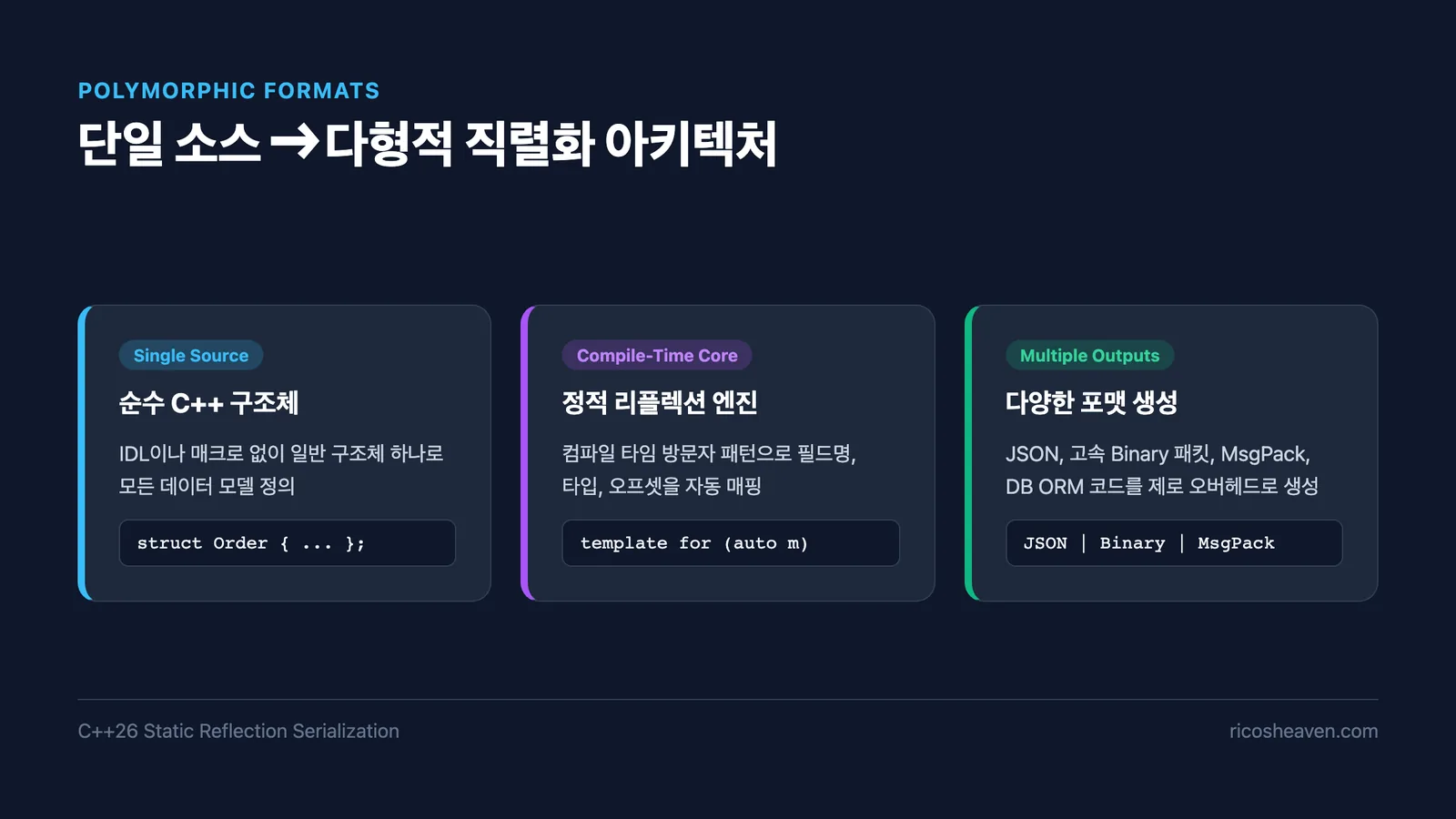
| Format Flexibility | Locked to archive format | Locked to Protobuf wire format | Infinite (JSON, Binary, MsgPack, DB ORM) |
6. Conclusion: A Unified Future for Serialization
C++26 Static Reflection completely modernizes data serialization:
- Single Source of Truth: One canonical C++ struct definition serves all formats simultaneously.
- Zero Maintenance Divergence: Adding or removing struct members automatically updates serialization logic.
- True Zero-Cost Abstraction: Pure compile-time evaluation leaves zero runtime overhead in production binaries.
7. Frequently Asked Questions (FAQ)
std::meta functions and ^^ operators execute strictly at compile time (consteval). The compiled binary contains only flat, direct member access instructions.