In ultra-low-latency financial trading infrastructure—spanning Home Trading Systems (HTS) and High-Frequency Trading (HFT)—C++26 marks a historic watershed moment. Standardized Contracts (P2900) and Static Reflection (P2996) eliminate cumbersome macros and complex Template Metaprogramming (TMP), enabling developers to achieve Zero-Overhead compile-time abstractions and mathematical correctness simultaneously.
This post provides an in-depth architectural breakdown with production-grade code examples illustrating how C++26 Contracts and Static Reflection transform trading software engineering.
1. The Eternal Dilemma in Trading Systems: Speed vs. Safety
Trading systems operate in an extreme domain where nanoseconds dictate market edge. Yet, a single invariant violation—such as a corrupted price tick or integer overflow in order quantity—can trigger catastrophic financial losses.
Historically, C++ engineers were forced to compromise:
- Runtime Branching Overhead: Scattering defensive
ifstatements across critical paths causes CPU Branch Mispredictions and instruction cache misses, ballooning tail latency. Conversely, relying on standardassertmacros leaves production release builds vulnerable or sub-optimized. - Serialization Macro Hell: Serializing hundreds of binary quote packets and FIX messages required convoluted X-Macros or heavy TMP, resulting in dreadful compile times and nearly impossible debugging.
C++26 resolves this conflict decisively through language-native Contracts and Static Reflection.
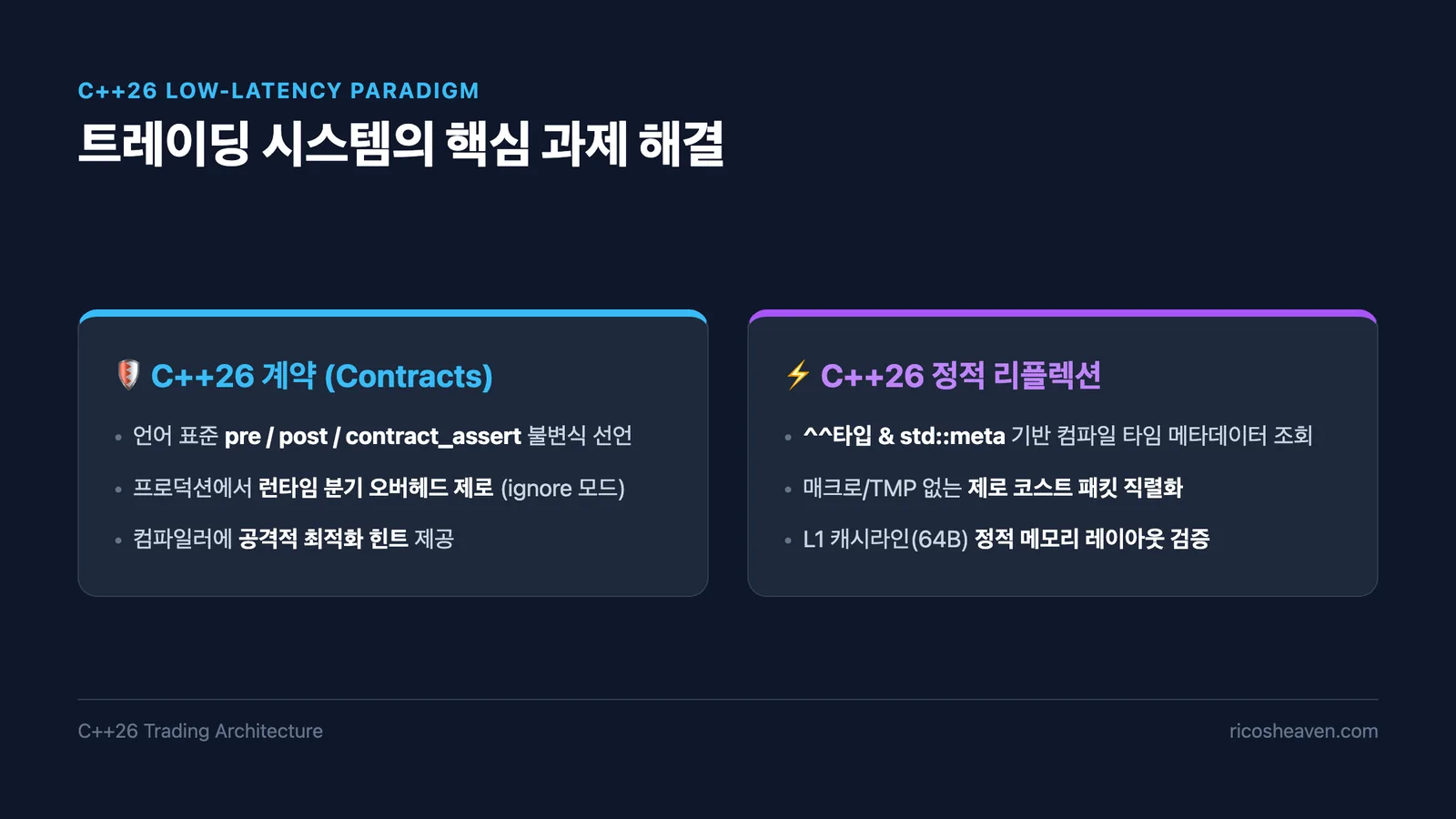
2. C++26 Contracts (P2900): Zero-Cost Invariant Enforcement & Optimization
C++26 Contracts provide language-level declarations for preconditions (pre), postconditions (post), and internal assertions (contract_assert).
2.1 Core Mechanics & Build Modes
Contracts allow precise runtime behavior configuration per build environment:
enforce: Immediately invokes contract violation handlers and aborts on breach (Unit test / Staging).observe: Logs violations and continues execution (Monitoring / Canary).ignore: Completely removes runtime checks while guiding the compiler optimizer to assume conditions are true (Production HFT).
2.2 Production Trading System Code Example
Applying C++26 Contracts to order entry and price validation:
// Order validation using C++26 Contracts
struct OrderRequest {
    uint32_t symbolId;
    int64_t  price;      // Tick price (must be positive)
    uint32_t quantity;   // Lot size (1 ~ MAX_ORDER_QUANTITY)
    OrderSide side;
};

struct ExecutionResult {
    bool success;
    uint64_t orderId;
    int64_t executedPrice;
};

constexpr uint32_t MAX_ORDER_QUANTITY = 100'000;

// Strong contract specifications in function signature
ExecutionResult SubmitOrder(const OrderRequest& req)
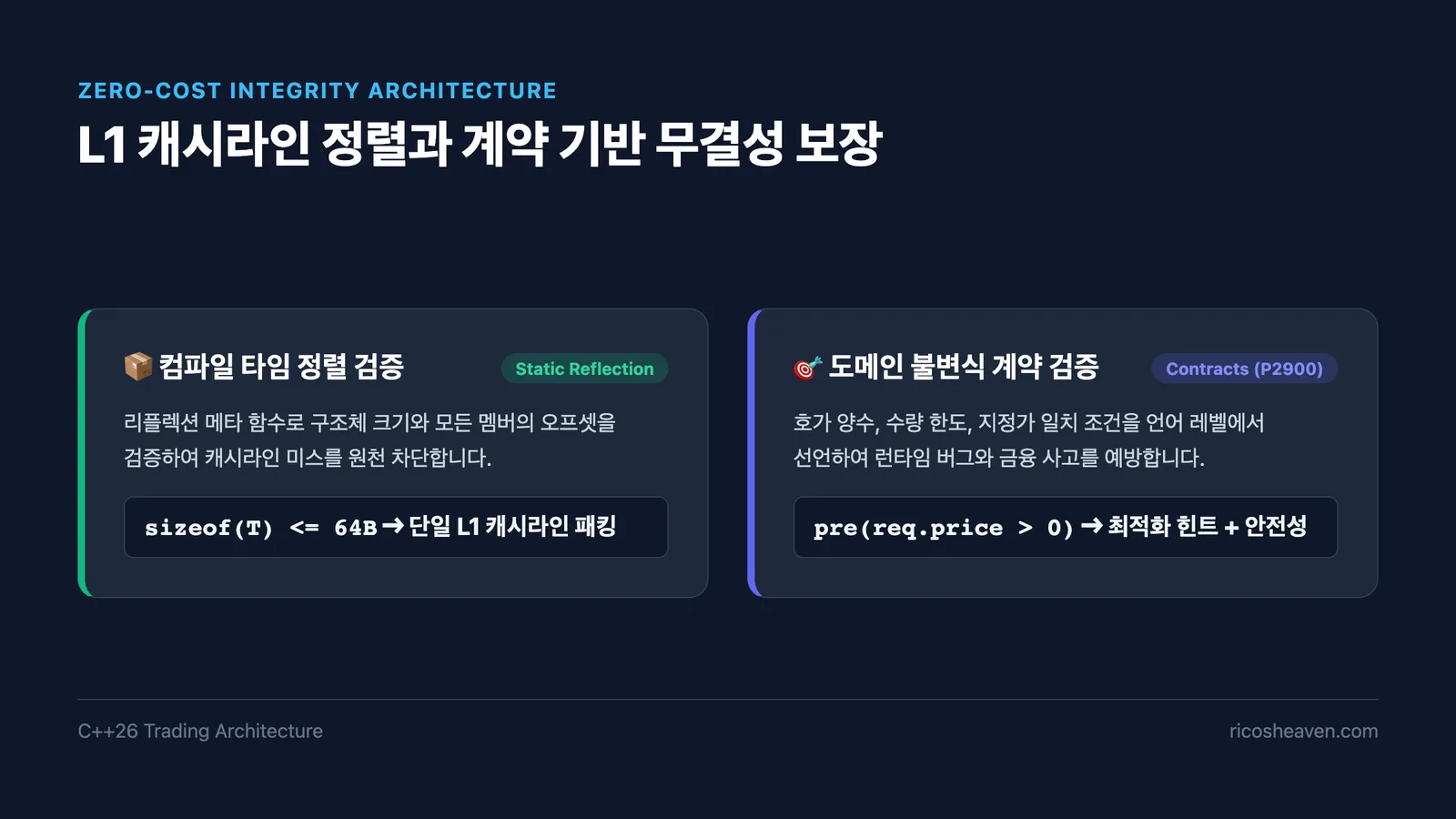
    pre(req.price > 0)                                          // Precondition 1: Positive price
    pre(req.quantity > 0 && req.quantity <= MAX_ORDER_QUANTITY) // Precondition 2: Bound quantity
    post(r: !r.success || r.executedPrice == req.price)         // Postcondition: Exact limit match
{
    contract_assert(req.symbolId != 0); // Internal invariant validation

    // Core order matching logic (eliminates redundant runtime guard branches)
    ExecutionResult result = MatchEngine::Process(req);
    return result;
}
Under the ignore build mode, zero branch instructions are generated. The CPU executes straight-line assembly while the optimizer leverages req.price > 0 for aggressive register allocation and loop vectorization.
3. C++26 Static Reflection (P2996): Zero-Cost Serialization
C++26 Static Reflection allows compile-time introspection of struct layouts, members, and metadata:
- Reflection Operator:
^^Tor^^expr(returns meta-handlestd::meta::info) - Meta Functions:
std::meta::members_of(...),std::meta::name_of(...), etc. - Splice Operator:
[: ... :](converts compile-time meta entities back into live C++ code)
3.1 Automated Binary Packet Serialization Example
A single generic serializer handles hundreds of market data packets without macros or runtime overhead:
#include <meta>
#include <string_view>
#include <span>

// Real-time stock execution packet
struct alignas(64) StockExecutionPacket {
    char     symbol[8];      // Symbol code
    int64_t  currentPrice;   // Trade price
    uint64_t volume;         // Cumulative volume
    int32_t  changeRate;     // Price change (bps)
    uint64_t timestampNs;    // Nanosecond timestamp
};

// Generic zero-overhead binary serializer using C++26 Static Reflection
template <typename T>
void SerializePacket(const T& packet, std::span<uint8_t> buffer) {
    size_t offset = 0;

    // Iterate over all members at compile time
    template for (constexpr auto member : std::meta::members_of(^^T)) {
        if constexpr (std::meta::is_nonstatic_data_member(member)) {
            using MemberType = typename[: std::meta::type_of(member) :];
            const auto& value = packet.[:member:]; // Direct member access via splice

            // Inlines to direct contiguous memory copy
            std::memcpy(buffer.data() + offset, &value, sizeof(MemberType));
            offset += sizeof(MemberType);
        }
    }
}
This template expands during compilation into direct, flattened memory copies, incurring 0% runtime abstraction penalty.

4. The Synergy of Contracts & Static Reflection
Uniting both features yields unprecedented reliability and development velocity in trading engines:
| Comparison Dimension | Legacy C++ (≤ C++20) | C++26 (Contracts + Reflection) |
|---|---|---|
| Invariant Checking | Macro assert or heavy if blocks |
Language-native pre/post (Zero cost in prod) |
| Packet Serialization | X-Macros, code generators, manual parsing | 100% automated compile-time std::meta::members_of |
| Optimizer Guidance | Opaque conditions; defensive codegen | Contracts serve as verified optimization hints |
| Memory Alignment | Runtime sizeof/offset assertions |
Compile-time static assertions on cacheline alignment |
| Maintainability | Manual updates across dozens of parsers | Modifying struct automatically updates all serializers |
4.1 Compile-Time Cacheline Alignment Verification
template <typename T>
consteval void ValidateTradingPacketLayout() {
    constexpr auto typeInfo = ^^T;
    static_assert(sizeof(T) <= 64, "Packet size exceeds single L1 Cacheline (64 bytes)!");

    // Verify member alignments to prevent unaligned cache split penalties
    template for (constexpr auto member : std::meta::members_of(typeInfo)) {
        if constexpr (std::meta::is_nonstatic_data_member(member)) {
            constexpr size_t memberOffset = std::meta::offset_of(member);
            static_assert(memberOffset % alignof(typename[: std::meta::type_of(member) :]) == 0,
                          "Unaligned member detected, causing memory penalty!");
        }
    }
}
5. Conclusion & Practical Takeaways
C++26 delivers three decisive advantages to modern trading architecture:
- Deterministic Latency: Zero runtime overhead in production while mathematically proving state invariants.
- Radical Code Simplification: Replaces thousands of lines of fragile macros and TMP with clean, declarative reflection code.
- Ironclad System Integrity: Compile-time cacheline validation combined with contract pre/post conditions prevents runtime crashes at their root.
With top quantitative trading firms like Citadel Securities actively piloting C++26 draft toolchains, embracing Contracts and Static Reflection is now essential for engineers building the next generation of high-performance trading platforms.
6. Frequently Asked Questions (FAQ)
assert(#expr) with NDEBUG merely erases the check into a no-op, hiding domain assumptions from the compiler. In contrast, C++26 Contracts in ignore mode instruct the compiler that preconditions are unconditionally true, allowing aggressive dead-branch elimination and vectorization.
typeid, dynamic_cast) incurs runtime metadata lookups and vtable overhead. C++26 Static Reflection is evaluated entirely at compile time, generating zero runtime metadata structures or memory footprints.