In financial trading systems (HTS/MTS) and real-time market data feed engines, parsing delimiter-separated stock code strings (delimited by ; or ,) hundreds of times per second is a routine yet critical operation.
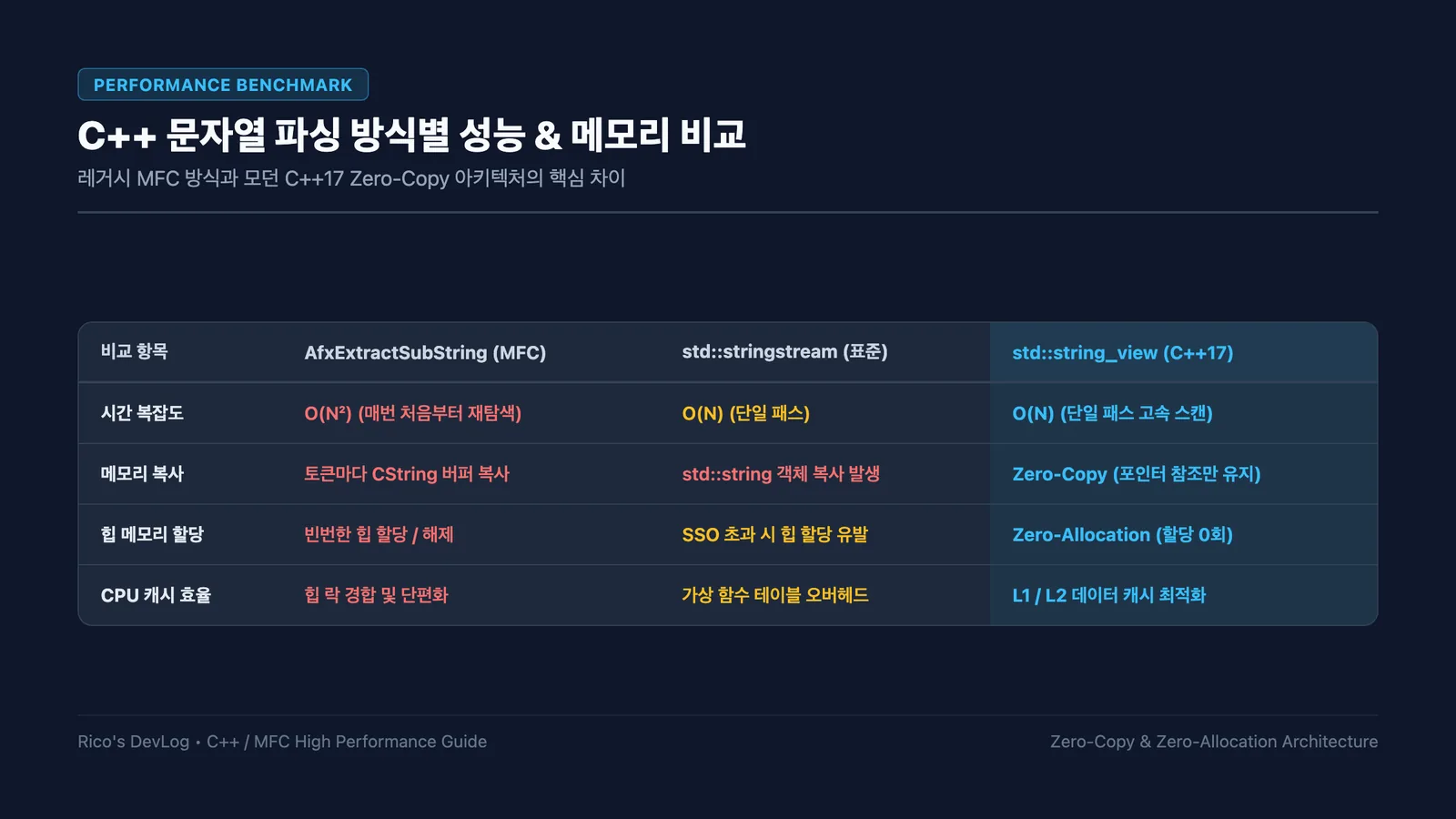
However, legacy parsing patterns frequently found in MFC environments—such as AfxExtractSubString, std::stringstream, or std::string::substr—incur significant dynamic heap allocations and memory copies for every token. This leads to heavy CPU bottlenecks, thread contention in the heap manager, and severe cache misses.
This guide explores high-performance string tokenizing techniques in modern C++ and MFC, focusing on Zero-Copy abstractions with C++17 std::string_view and Zero-Allocation pointer traversal with callback patterns.
1. Why Do Traditional C++ and MFC String Parsing Methods Suffer from Bottlenecks?
In legacy C++ codebases, the two primary culprits behind parsing performance degradation are inefficient $O(N^2)$ repetitive scanning algorithms and frequent dynamic heap allocations.
1.1 O(N²) Time Complexity of AfxExtractSubString and CString Heap Allocation
In MFC applications, AfxExtractSubString is often called in a loop to extract tokens. However, internally it scans the string from the very beginning on every single call to locate the $i$-th delimiter.
// [Inefficient Example] AfxExtractSubString parsing
CString strCodes = _T("005930;000660;035420;005380;068270;...");
CString strToken;
int i = 0;
while (AfxExtractSubString(strToken, strCodes, i++, _T(';'))) {
    // Re-scans from index 0 every call and reallocates CString heap buffers
    // For 1,000 tokens, up to 500,000 redundant character comparisons occur (O(N^2))
}
For $N$ tokens, the total complexity escalates to $O(N^2)$. Furthermore, constructing and destructing CString objects on each iteration introduces substantial heap allocation overhead.
1.2 Memory Copy Overhead with std::stringstream and std::string::substr
The standard C++ combination of std::stringstream and std::getline is also ill-suited for hot-path systems.
// [Inefficient Example] Using std::stringstream
std::stringstream ss(codes);
std::string item;
while (std::getline(ss, item, ';')) {
    // Virtual function calls + dynamic memory allocations for std::string
}
std::stringstream involves virtual table lookups and stream buffer setup costs. If token lengths exceed the Small String Optimization (SSO) capacity (typically ~15 bytes) or if token counts are large, repeated heap allocations trigger frequent L1/L2 CPU cache misses.
2. Solution 1: Zero-Copy Fast Parsing with std::string_view
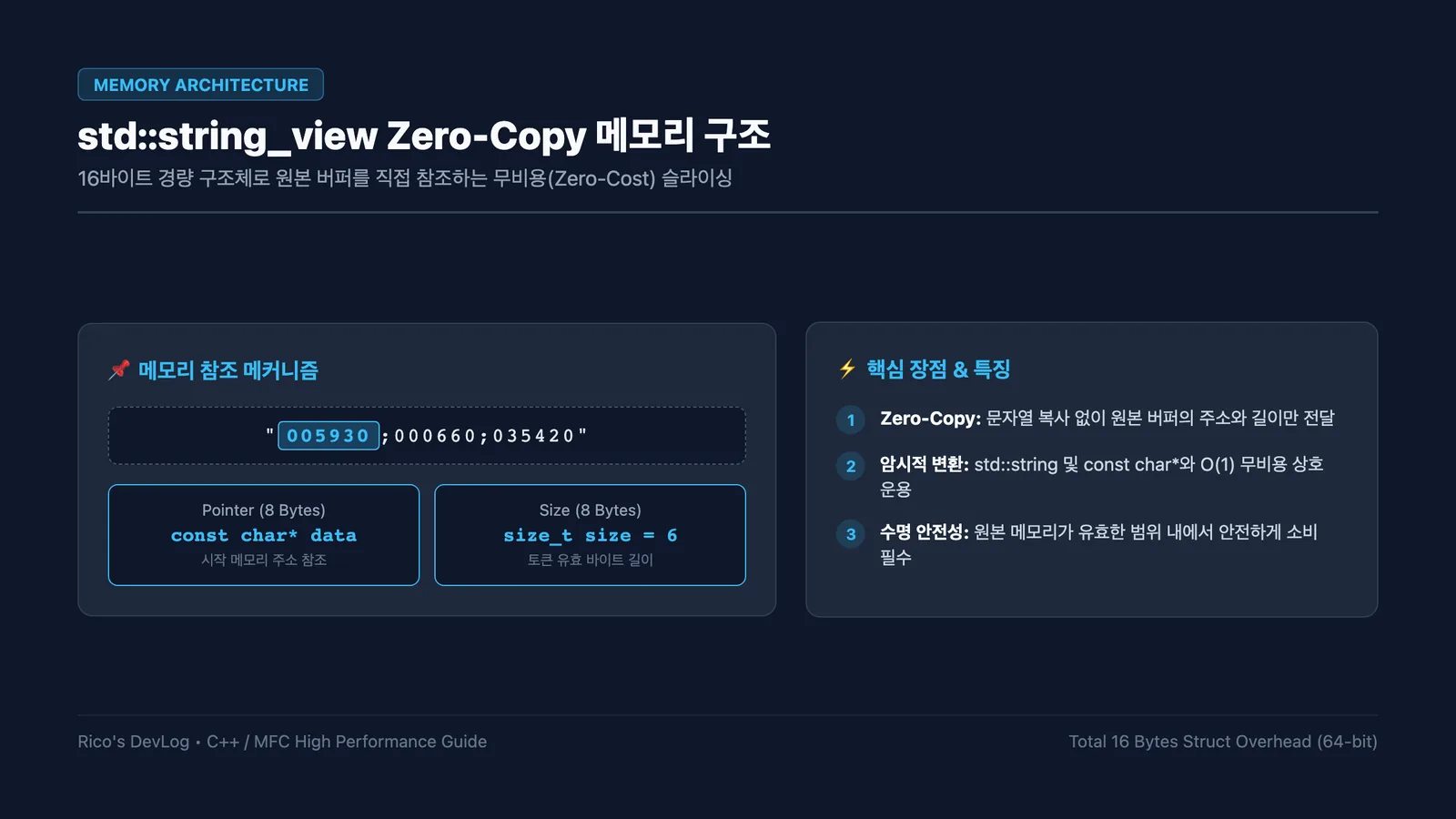
Introduced in C++17, std::string_view is a lightweight non-owning view consisting only of a pointer (const char*, 8 bytes) and a length (size_t, 8 bytes), totaling 16 bytes on 64-bit platforms.
2.1 Implementing std::string_view Tokenizer
By scanning the input string in a single linear pass ($O(N)$), delimiters are located and sliced directly into std::string_view instances.
#include <string>
#include <string_view>
#include <vector>

std::vector<std::string_view> SplitCodesFast(std::string_view codes)
{
    std::vector<std::string_view> result;
    // Pre-allocate buffer capacity to prevent vector reallocations
    result.reserve(128);

    size_t start = 0;
    size_t end = codes.find(';');

    while (end != std::string_view::npos)
    {
        if (end > start) // Guard against empty tokens
        {
            result.emplace_back(codes.data() + start, end - start);
        }
        start = end + 1;
        end = codes.find(';', start);
    }

    // Process trailing token
    if (start < codes.size())
    {
        result.emplace_back(codes.data() + start, codes.size() - start);
    }

    return result;
}- Zero-Copy Guarantee: Token slices are created via simple pointer arithmetic without duplicating character arrays.
reserve(128): Pre-allocating the vector prevents geometric buffer resizing and redundant reallocation overhead.
3. Solution 2: Direct Pointer Traversal & Callback (Zero-Allocation)
Even pushing tokens into a std::vector incurs minor container memory allocation. For ultra-low latency packet parsers and real-time tick receivers, a callback (lambda) architecture eliminates all heap allocations (Zero-Allocation).
3.1 Pointer Traversal Template Implementation
#include <string>
#include <string_view>

template <typename Func>
inline void ForEachCodeFast(const std::string& codes, Func&& callback)
{
    const char* start = codes.data();
    const char* end = start + codes.size();
    const char* current = start;

    while (current < end)
    {
        if (*current == ';')
        {
            if (current > start)
            {
                callback(std::string_view(start, static_cast<size_t>(current - start)));
            }
            start = current + 1;
        }
        ++current;
    }

    if (start < end)
    {
        callback(std::string_view(start, static_cast<size_t>(end - start)));
    }
}

// [Usage Example]
void ProcessIncomingPacket(const std::string& rawCodes)
{
    ForEachCodeFast(rawCodes, [](std::string_view code) {
        // Perform CString conversions only when binding to MFC UI controls
        // Process business logic, map lookups, and packet routing directly with string_view
    });
}- Single-Pass Traversal: Incrementing a raw pointer directly invokes the callback with sliced views as delimiters are found.
- Zero-Allocation Architecture: No dynamic heap containers are constructed, maximizing CPU L1 cache locality.
4. Technical Analysis & Practical Q&A
Q1. If SplitCodesFast accepts std::string_view, can we pass std::string or string literals directly?
Answer: Yes, perfectly. An $O(1)$ zero-cost implicit conversion occurs.
std::string_view provides non-explicit constructors accepting const std::string& and const char*. At compile time, the compiler extracts the data pointer and size, passing a 16-byte stack structure with zero heap allocations or copies.
std::string myCodes = "005930;000660;035420";

auto res1 = SplitCodesFast(myCodes);         // std::string -> O(1) implicit conversion
auto res2 = SplitCodesFast("005930;000660"); // const char* -> O(1) implicit conversionstd::string_view does not own the underlying memory. Ensure the original std::string or buffer remains valid for the duration of the view's usage to prevent dangling pointer bugs.
Q2. Why use emplace_back instead of push_back?
Answer: To eliminate temporary object creation and copy/move operations on the stack.
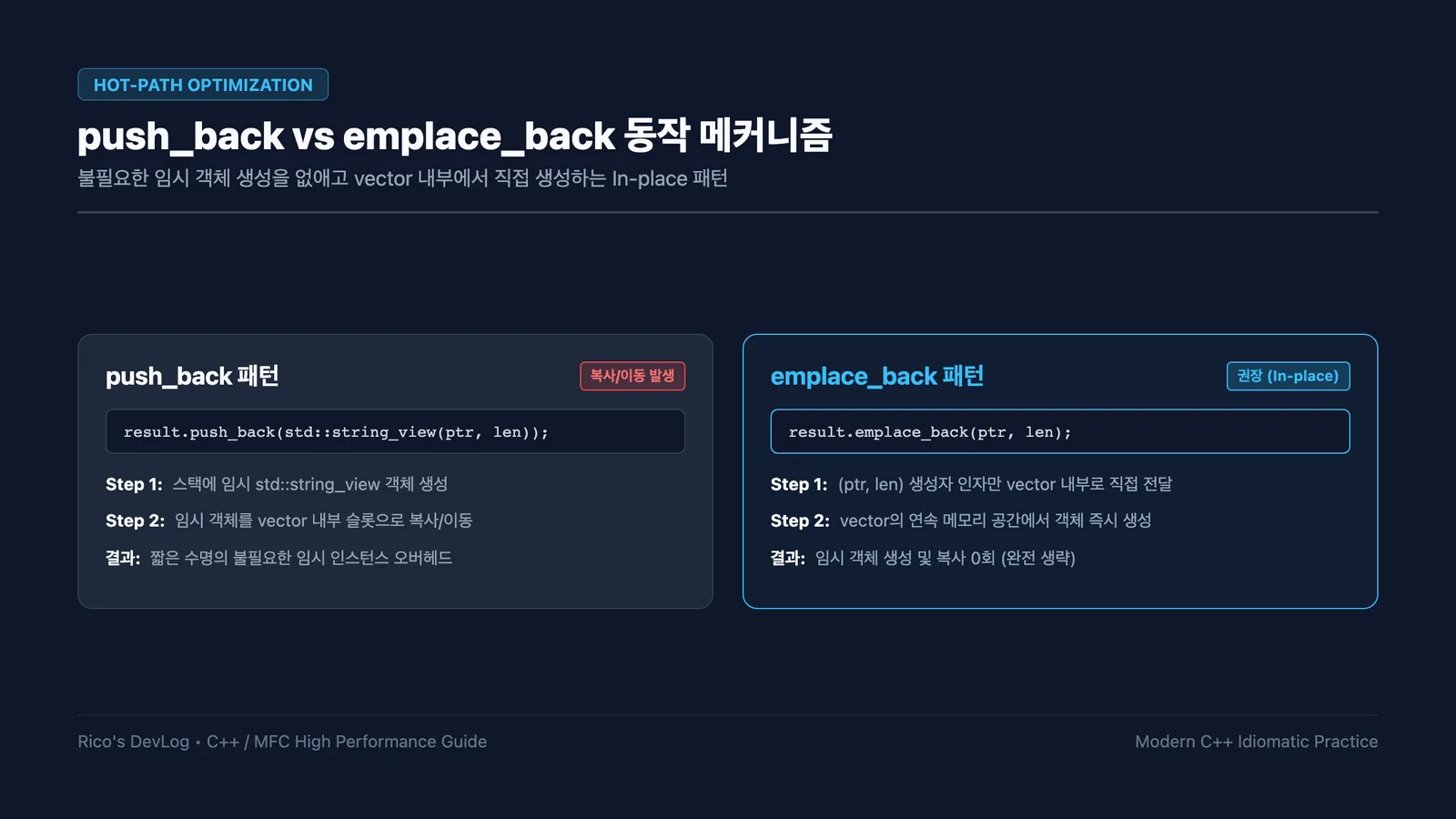
- With
push_back:- Constructs a temporary
std::string_viewon the stack. - Copies or moves the temporary object into the vector's allocated slot.
- Constructs a temporary
- With
emplace_back(In-place Construction):- Forwards constructor arguments
(pointer, length)directly into the vector buffer. - Constructs the
std::string_viewdirectly in place (zero temporary instances).
- Forwards constructor arguments
In hot-path optimization loops, in-place construction with emplace_back is standard modern C++ idiom for minimal instruction overhead.
5. Additional Optimization Strategies for Trading & MFC Applications
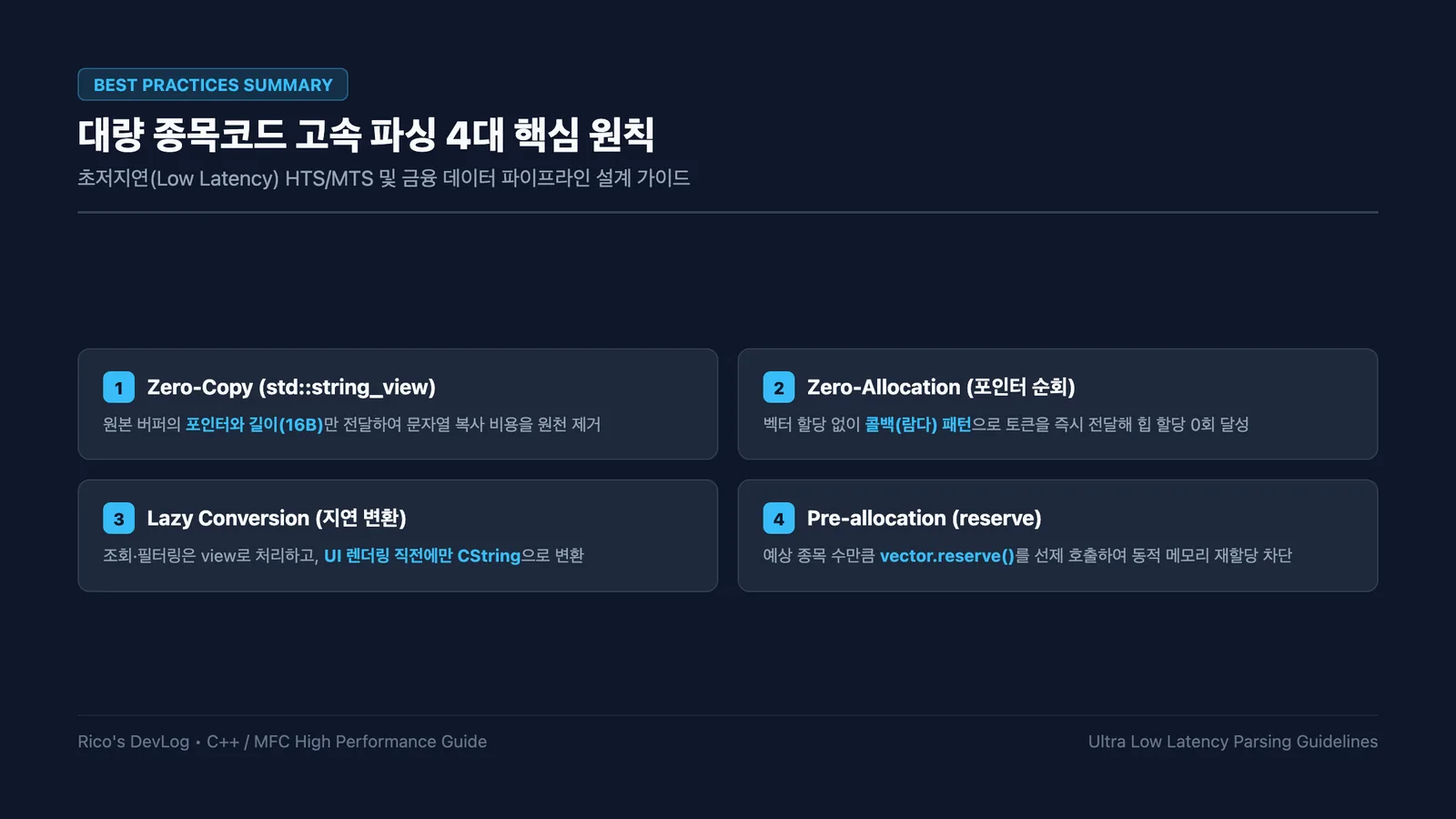
1) Lazy CString Conversion
Keep token representations as std::string_view for lookups, business logic, and routing. Defer CString creation until the moment of UI rendering into MFC controls (e.g., CListCtrl, CEdit) via CString(code.data(), static_cast<int>(code.size())).
2) Pre-allocating Buffer Capacity (reserve)
Estimating the average batch size of incoming codes (e.g., 64 or 128 items) and pre-allocating memory with vector::reserve() eliminates dynamic resizing bottlenecks.
3) SIMD (AVX2/SSE) Vectorized Acceleration
For high-throughput real-time packet distributors processing thousands of continuous stream bytes, SIMD vectorization (using _mm_loadu_si128 and vectorized memchr) allows scanning 16 to 32 bytes per instruction.
6. Summary
- Zero-Copy: Leverage
std::string_viewto pass only pointers and lengths, bypassing string copies. - Zero-Allocation: Apply direct pointer traversal and lambda callbacks to achieve 0 heap allocations.
- Modern C++ Best Practices: Utilize
emplace_backin-place construction andreserve()capacity hints for optimal execution speed.