Sunday, August 23, 2026 — Without ever opening traditional video editing tools like Adobe Premiere Pro or After Effects, turning raw text scripts into high-quality motion graphics videos in under 20 minutes has become a reality.
A recently published technical retrospective on YouTube (Video Link), titled "The Secret to AI Video Automation After 30 Days of Struggle," chronicles 190 hours of deep engineering to fully automate motion graphics video production using Remotion (React-based programmatic video rendering) and Claude Code.
Beyond simple tool chaining, this journey uncovers fundamental prompt engineering insights: how trimming 1,800 lines of micro-rules down to just 5 core principles unlocked AI's creative visual execution.
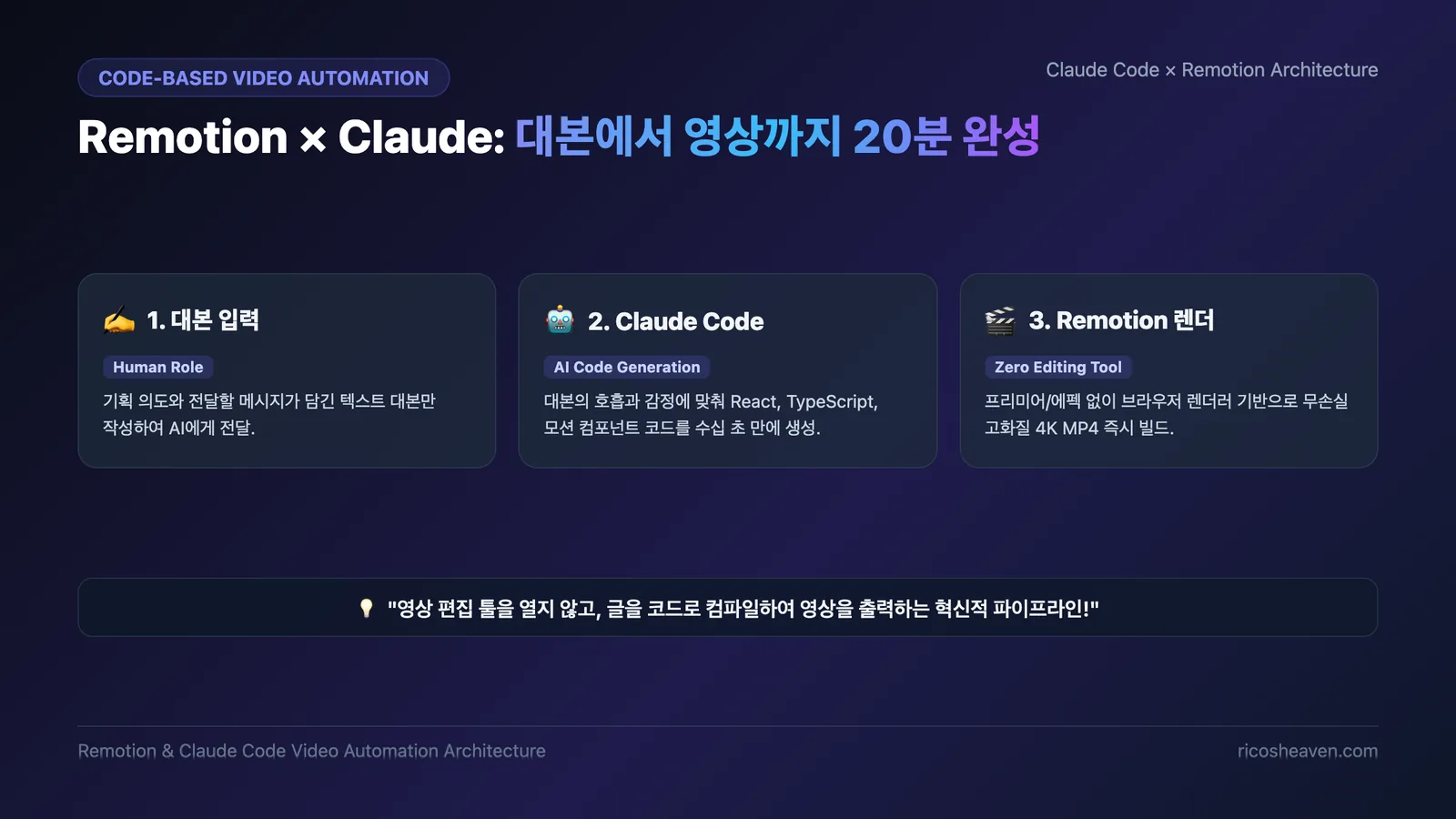
1. Remotion × Claude Code: Rendering Motion with Code
Traditional editing treats video as manual timeline slicing. In contrast, Remotion expresses video compositions programmatically using web standard technologies (React, TypeScript, CSS, Canvas).
- How It Works: Layouts, kinetic typography, charts, and spring-physics animations are written as React components. The Remotion CLI compiles them via headless browser rendering into pristine, lossless 4K MP4 videos.
- Synergy with Claude Code: Instead of manually programming UI components, creators supply the script to Claude Code, which authors the corresponding React/Remotion code in seconds.
While the end result generates finished motion graphics in 20 minutes, arriving at this architecture required overcoming 190 hours of painful failures.
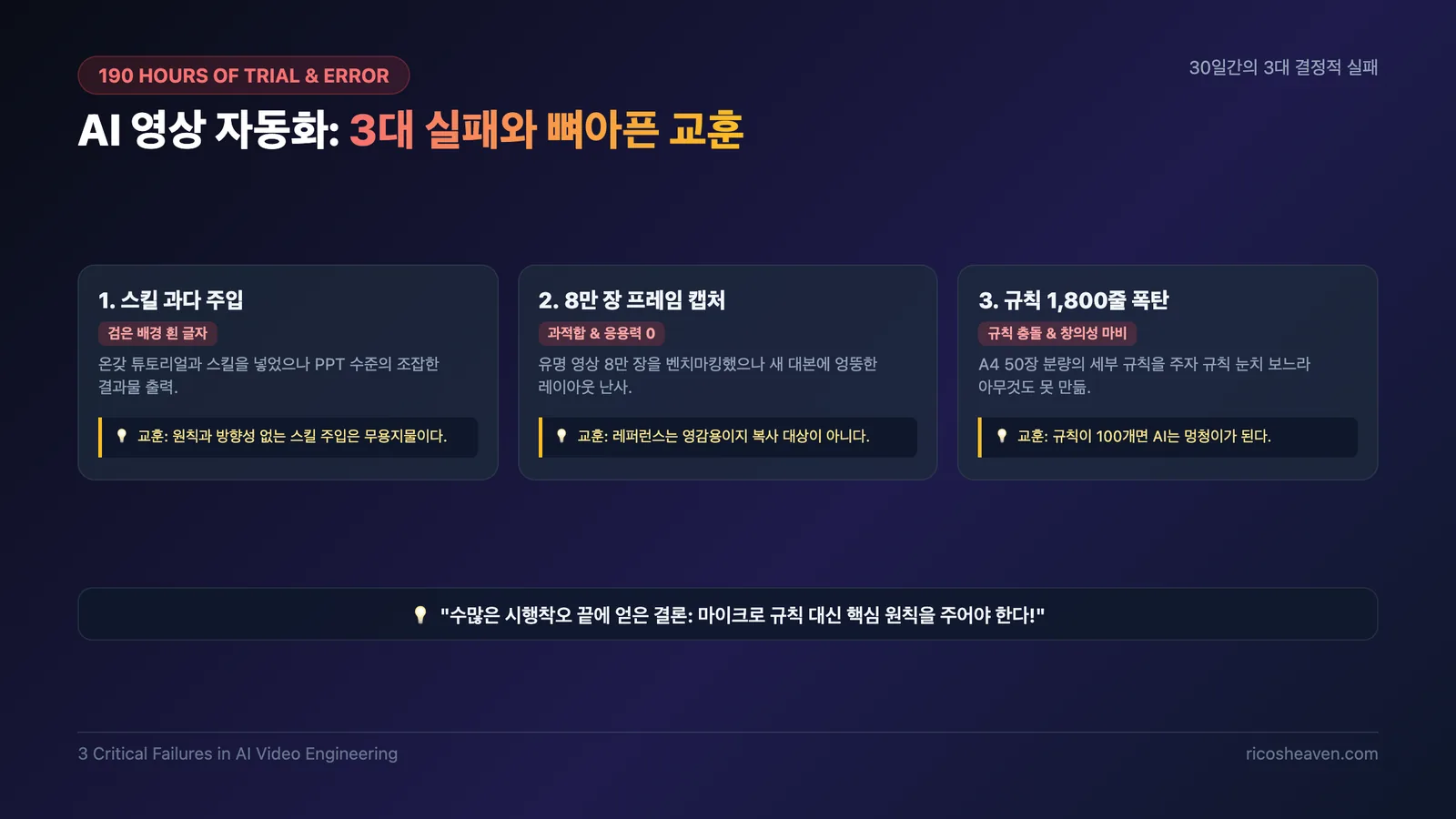
2. 3 Critical Failures Across 190 Hours of Experimentation
1) Failure 1: Stuffing Skills & Best Practices Without Direction
- Process: Injected every Remotion best practice, animation tutorial, chart recipe, and transition skill into Claude simultaneously.
- Outcome: Generated crude, static slides—white text on a plain black background resembling raw PowerPoint recordings.
- Lesson: "Skills without overarching principles and direction are useless." Giving a chef ten knives without a recipe yields no dish.
2) Failure 2: Overfitting on 80,000 Frame Captures
- Process: Exported 10 minutes of top-tier YouTube reference videos frame-by-frame (80,000 PNGs) using Final Cut Pro and instructed Claude to memorize exact layout transition patterns.
- Outcome: Perfectly cloned the training reference, but suffered a complete breakdown (0 generalization) when given a new script.
- Lesson: "References are for inspiration, not replication." Rote memorization destroys adaptability.
3) Failure 3: The 1,800-Line Micro-Rule Trap
- Process: Documented an exhaustive 50-page guide (1,800 lines) covering exact font sizes, color conditions, and 30 strict prohibitions.
- Outcome: AI became paralyzed trying not to violate conflicting rules, rendering zero creative visuals.
- Lesson: "When given 100 rules, AI turns rigid; when given 5 principles, AI becomes creative." Memorizing a 1,000-page driving manual prevents you from knowing which way to turn the wheel.
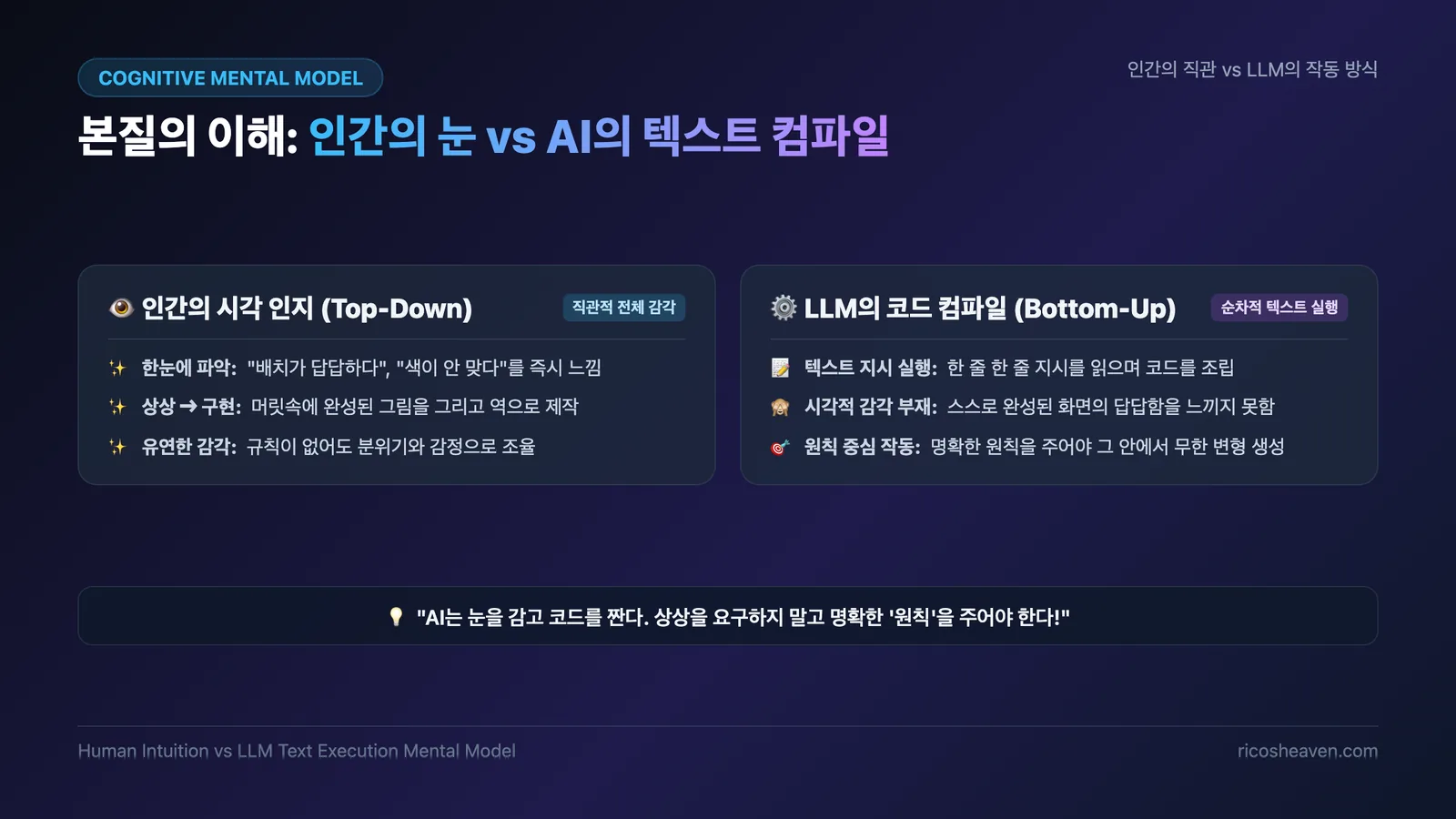
3. The Breakthrough Question: "Why Can't AI 'Feel' Visuals?"
After modifying over 500 files in vain, a fundamental question emerged:
When asked directly, Claude provided a candid answer:
This revealed the core mistake: demanding that someone paint a landscape with their eyes closed.
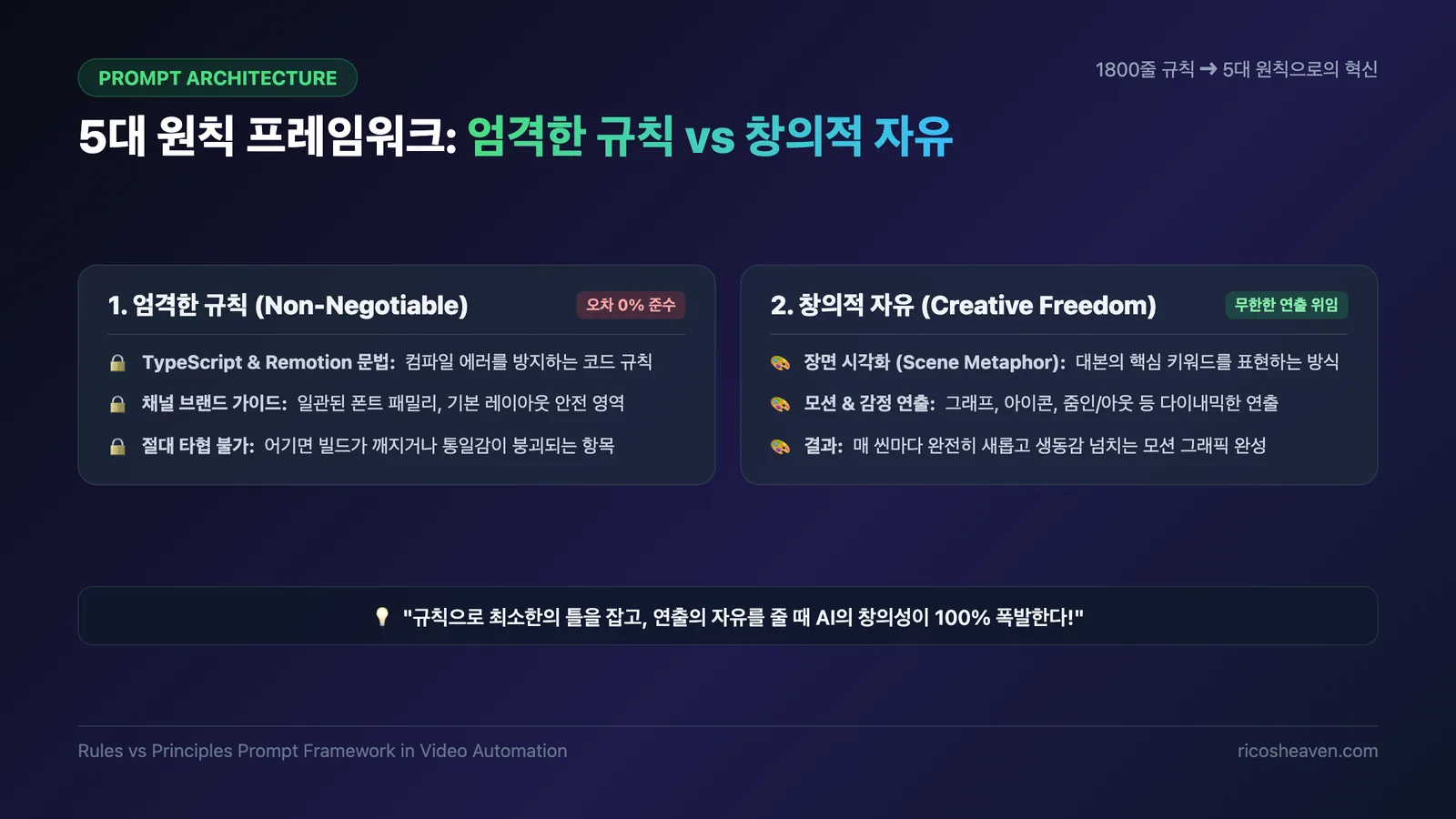
4. From 1,800 Lines to 5 Golden Principles
Recognizing how LLMs truly operate, the 1,800-line constraint document was discarded and replaced with 5 core principles dividing responsibility:
- Strict Rules (Non-Negotiable):
- Brand style palettes, TypeScript compilation syntax, and Remotion component constraints must be followed with 100% precision to prevent build failures.
- Creative Freedom (Autonomous Execution):
- Scene visual metaphors, motion pacing, and emotional expression are fully delegated to the AI's creative variation capability.
The result was transformative: replacing micro-constraints with 5 high-level principles enabled Claude to autonomously produce distinct, dynamic, and engaging motion graphics for every single scene.
5. The Golden Rule of AI Engineering: "How Does It Work?"
This 30-day journey offers an essential lesson for developers, creators, and engineers building with AI:
- When AI fails, avoid endlessly asking "Why didn't this work? Should I patch another symptom or add more rules?"
- Instead, ask "How does this AI model actually operate internally?"
By aligning with the LLM’s cognitive architecture and replacing micro-management with principled autonomy, developers can unlock the true power of autonomous AI workflows.