Sunday, August 23, 2026 — Despite rapid advances in web standards, building desktop-class web applications—such as real-time massive data visualizers, CAD/vector graphics engines, high-frequency financial charts, and local AI model inference—frequently exposes the architectural limitations of pure JavaScript (JS).
According to recent industry benchmarks and tech reports (Agility CMS, daily.dev 2026), compiling high-performance C/C++ and Rust cores directly into browser runtimes via WebAssembly (Wasm) has matured from an experimental approach into an essential enterprise architecture pattern.
Here is an architectural breakdown of how industry leaders like Figma, Adobe, and DuckDB achieve near-native performance on the web, paired with actionable Zero-Copy C++ Emscripten implementation patterns.
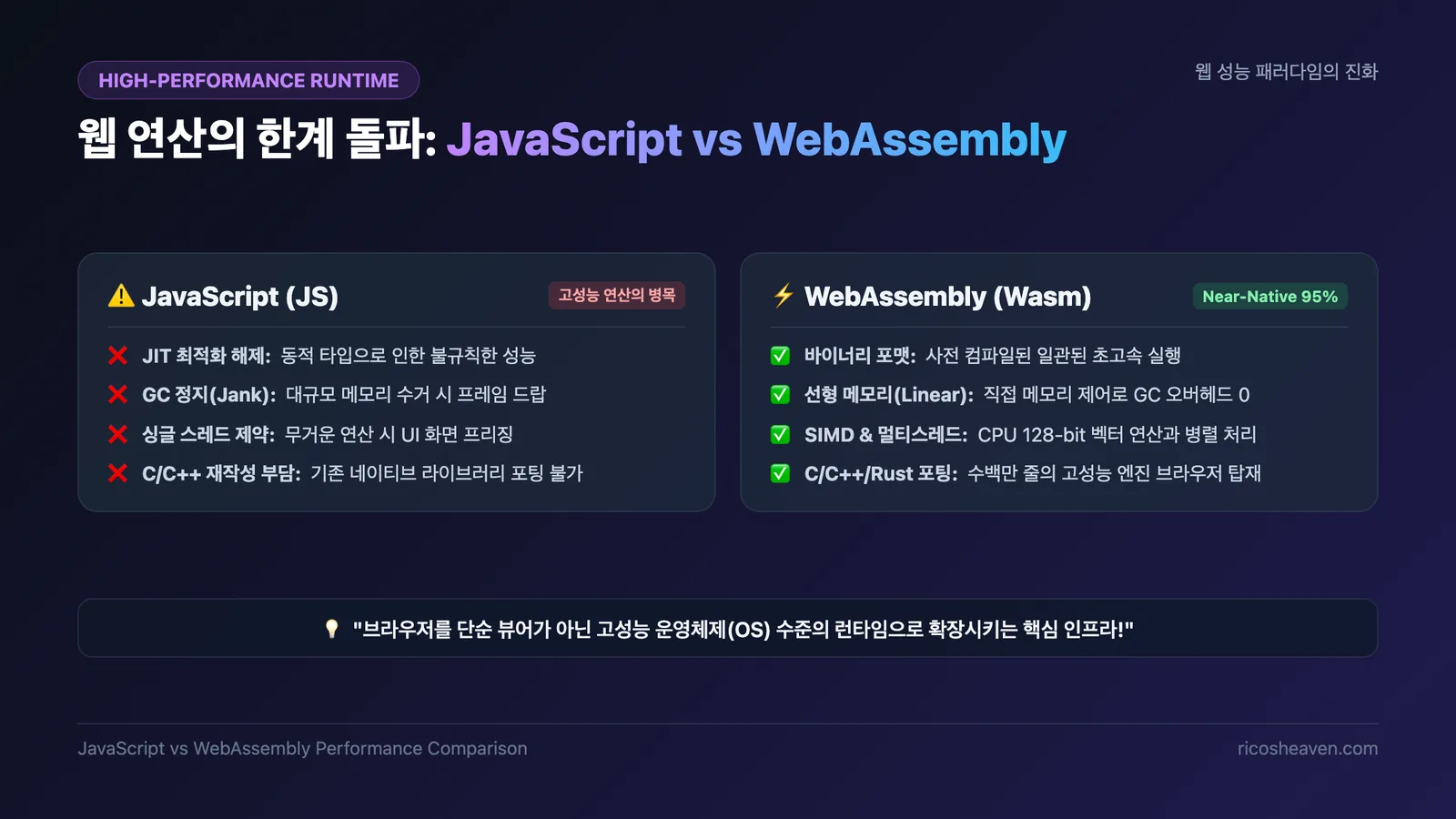
1. Why WebAssembly (Wasm)? Understanding JavaScript Bottlenecks
As web software scales to desktop complexity, fundamental characteristics of the JavaScript engine impose predictable bottlenecks:
1) Core JavaScript Performance Bottlenecks
- JIT Warm-up & Deoptimization: Dynamic typing forces JIT compilers to speculate on types. When types fluctuate, deoptimization cascades cause latency spikes.
- Garbage Collection (GC) Pauses (Jank): Rapid allocation/deallocation during data-heavy processing triggers unpredictable GC cycles, dropping frames.
- Single-Threaded Event Loop: CPU-heavy numerical routines block the main thread, freezing the UI and user input.
2) WebAssembly's Structural Advantages
WebAssembly runs as a compact binary instruction format inside a secure browser virtual machine (Wasm VM):
- Near-Native Speed (~95%): Ahead-Of-Time (AOT) compiled from static languages like C/C++ and Rust, ensuring consistent, predictable execution without JIT pauses.
- Linear Memory Control: Direct developer-managed memory allocation eliminates garbage collection overhead.
- 128-bit SIMD & Concurrency: Direct hardware vectorization and true multithreading via
SharedArrayBufferand Web Workers.
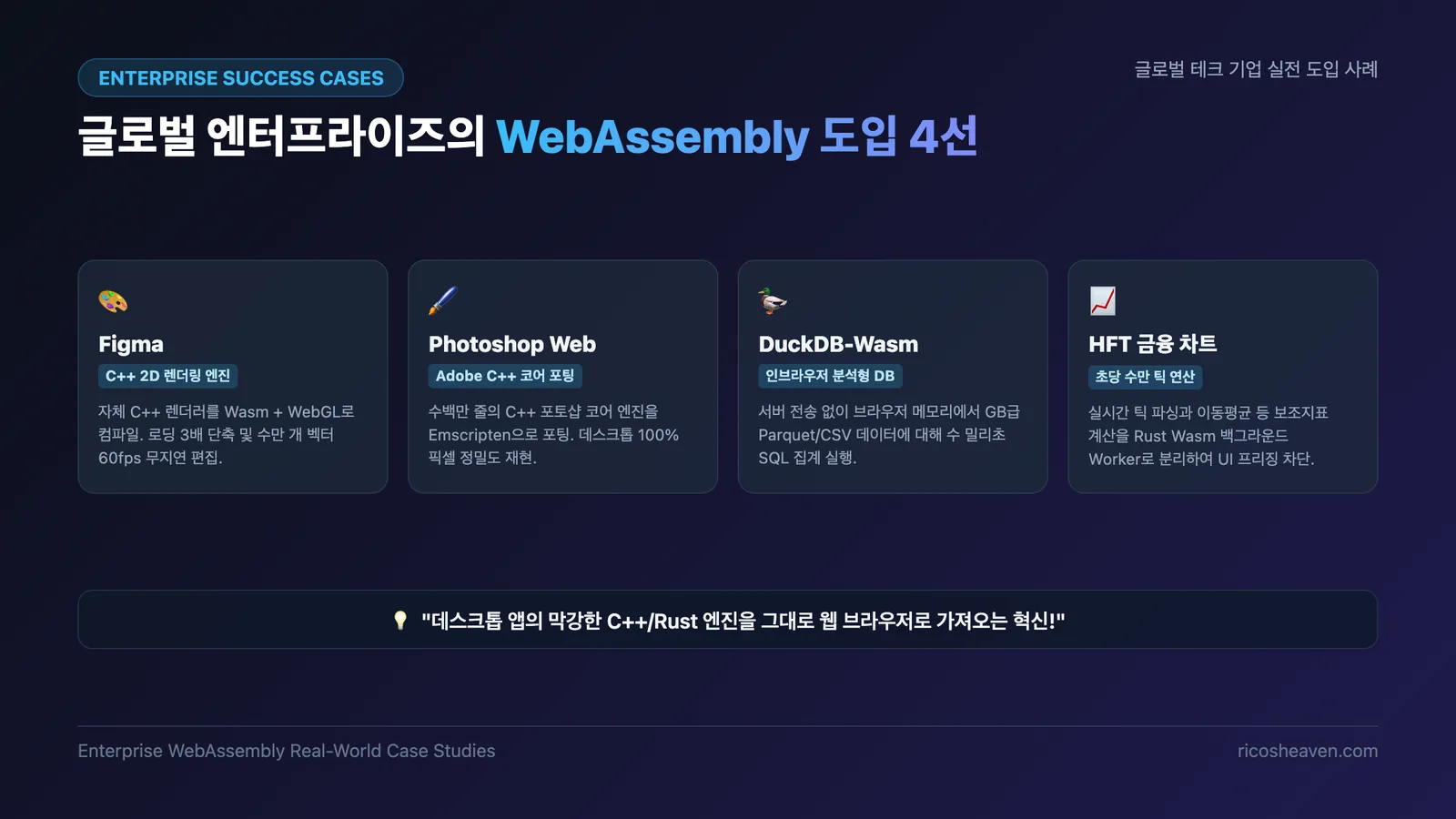
2. 4 Enterprise WebAssembly Case Studies
Wasm powers the core computational foundations of several mission-critical web platforms:
1) Figma: The Gold Standard for Web-Based Vector Graphics
To overcome DOM and 2D Canvas rendering bottlenecks across tens of thousands of vector paths, Figma compiled their custom C++ 2D vector renderer directly into Wasm with WebGL/WebGPU. This achieved a 3x faster load time and guaranteed 60fps real-time manipulation of complex vector trees.
2) Adobe Photoshop on the Web: Reusing Decades of C++ Assets
Rather than rewriting millions of lines of proven C++ algorithms, Adobe used Emscripten to compile their core Photoshop image processing libraries (LibRaw, custom pixel shaders, blending filters) into WebAssembly, achieving 100% pixel parity with desktop Photoshop.
3) DuckDB-Wasm: Zero-Server-Cost In-Browser OLAP Database
DuckDB-Wasm ports the state-of-the-art columnar C++ analytical database directly to the client. It enables users to execute complex SQL queries across gigabytes of Parquet and CSV files in local browser RAM within single-digit milliseconds—incurring zero backend cloud infrastructure costs.
4) TradingView & High-Frequency Financial Charts
To prevent UI lockups when streaming tens of thousands of market ticks per second, financial platforms offload tick parsing and technical indicators (EMA, Bollinger Bands, RSI) to background Wasm workers, streaming only rendered buffers to WebGL/WebGPU canvases.
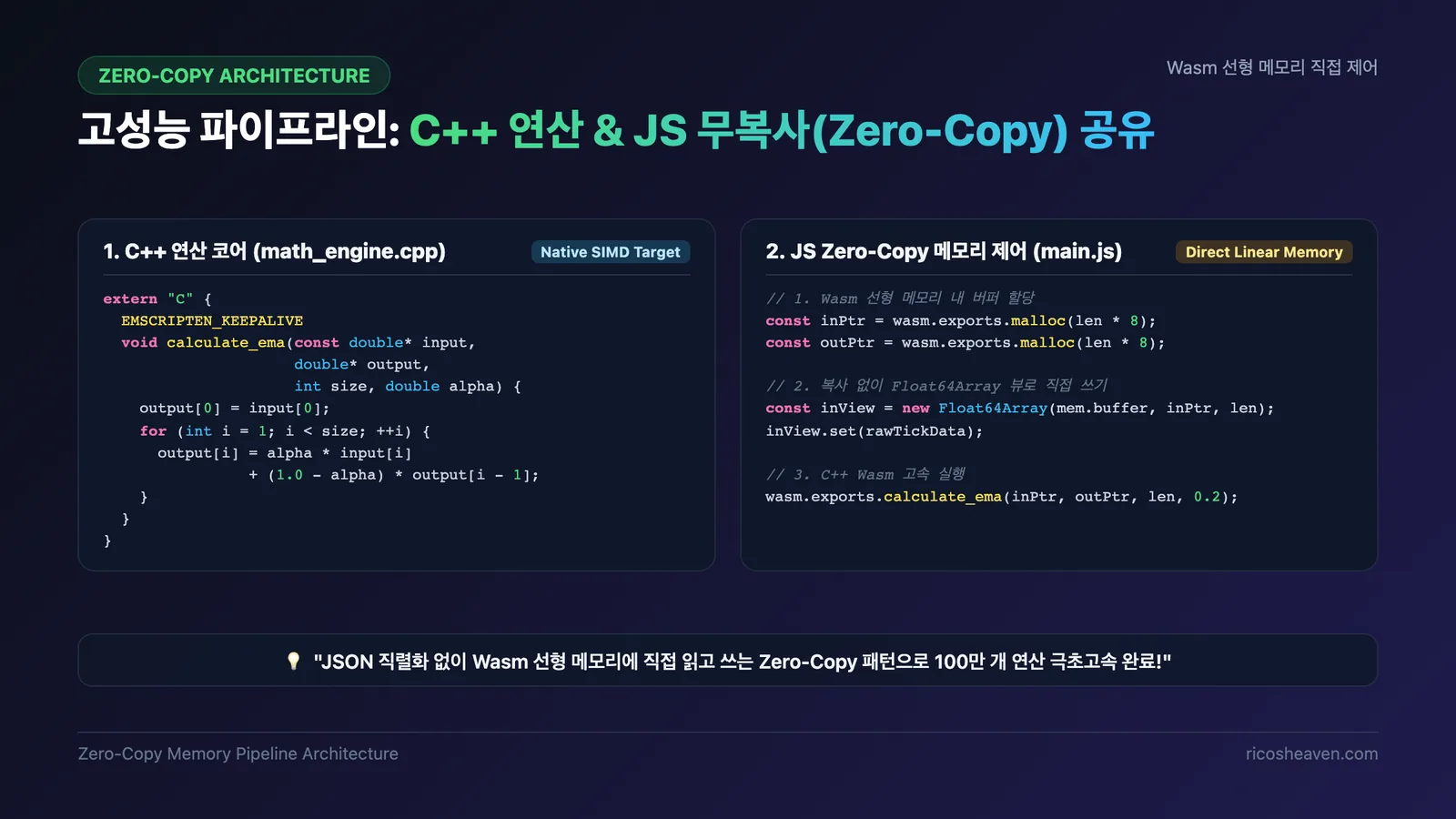
3. High-Performance Wasm Architecture: C++ & Zero-Copy Memory
The golden rule of high-performance Wasm engineering is to avoid serializing data across the JS-Wasm boundary and instead manipulate Wasm's Linear Memory directly.
1) High-Speed C++ Math Kernel (math_engine.cpp)
An Exponential Moving Average (EMA) algorithm optimized for batch streaming:
#include <emscripten/emscripten.h>
#include <vector>

extern "C" {
    // Exported for JavaScript invocation
    EMSCRIPTEN_KEEPALIVE
    void calculate_ema(const double* input, double* output, int size, double alpha) {
        if (size <= 0) return;

        output[0] = input[0];
        for (int i = 1; i < size; ++i) {
            output[i] = alpha * input[i] + (1.0 - alpha) * output[i - 1];
        }
    }
}
2) Compiling with Emscripten
emcc math_engine.cpp -O3 -s WASM=1 -s EXPORTED_RUNTIME_METHODS='["cwrap", "getValue", "setValue"]' -o math_engine.js3) Zero-Copy Frontend Bridge (main.js)
Directly mapping a JavaScript Float64Array view over Wasm linear memory buffers:
// main.js - Asynchronously load Wasm and execute zero-copy calculations
async function runHighPerformanceAnalysis() {
    const response = await fetch('math_engine.wasm');
    const buffer = await response.arrayBuffer();
    const wasmModule = await WebAssembly.instantiate(buffer);
    const { calculate_ema, memory } = wasmModule.instance.exports;

    const dataLength = 1_000_000; // 1,000,000 tick records
    const bytesPerElement = Float64Array.BYTES_PER_ELEMENT; // 8 bytes

    // 1. Allocate input/output buffers inside Wasm linear memory
    const inputPointer = wasmModule.instance.exports.malloc(dataLength * bytesPerElement);
    const outputPointer = wasmModule.instance.exports.malloc(dataLength * bytesPerElement);

    // 2. Wrap typed array views directly around Wasm memory (Zero-Copy)
    const inputView = new Float64Array(memory.buffer, inputPointer, dataLength);
    for (let i = 0; i < dataLength; i++) {
        inputView[i] = Math.sin(i * 0.05) * 100 + Math.random() * 10;
    }

    // 3. Execute compiled C++ routine
    console.time("Wasm EMA Calculation");
    calculate_ema(inputPointer, outputPointer, dataLength, 0.2);
    console.timeEnd("Wasm EMA Calculation"); // 1M calculations finish in single-digit ms

    // 4. Read output and release memory
    const outputView = new Float64Array(memory.buffer, outputPointer, dataLength);
    console.log("Sample Result:", outputView.slice(0, 5));

    wasmModule.instance.exports.free(inputPointer);
    wasmModule.instance.exports.free(outputPointer);
}
4. The 2026 WebAssembly Technology Landscape
WebAssembly is evolving beyond traditional C/C++ porting into a ubiquitous cross-platform runtime:
- WasmGC (Garbage Collection Standard): Enables managed languages (Kotlin Multiplatform, Dart/Flutter Web, Go) to run natively on Wasm without bundling bloated garbage collector runtimes.
- WebGPU + Wasm Synergy: Direct GPU hardware acceleration combined with Wasm enables AAA-tier 3D rendering and real-time physics simulations in web browsers.
- On-Device In-Browser AI:
Runtimes like
WebLLMandONNX Runtime Webutilize Wasm SIMD and local GPUs to execute private local LLMs and computer vision models entirely client-side.
5. Engineering Conclusion: The Modern Browser as an Operating System
WebAssembly is not merely a JavaScript replacement—it transforms the modern browser into a high-performance, sandboxed operating system.
- Cloud Cost Reduction: Offloading computation from expensive cloud server clusters to client hardware.
- Legacy Asset Preservation: 100% reuse of proven, battle-tested native C/C++ algorithms.
- Flawless User Experience: Sustained 60–120fps smooth interactivity without GC stutter.
As the boundaries between systems engineering and web architecture dissolve, mastering WebAssembly is no longer optional for modern performance engineers.