Sunday, August 23, 2026 — As the primary development environment for Windows systems, AAA game development, and high-performance infrastructure, Visual Studio has officially released its latest MSVC v14.50 Compiler Toolset Update.
This release represents a major engineering milestone: 100% completion of the C++23 Standard Library (STL), early preview support for C++26 features (Pack Indexing, Static Reflection parser), and significant build throughput accelerations for massive C++ codebases (Unreal Engine 5, LTCG link time reduction).
Here is a comprehensive breakdown of the essential features, architectural optimizations, and code patterns in MSVC v14.50.
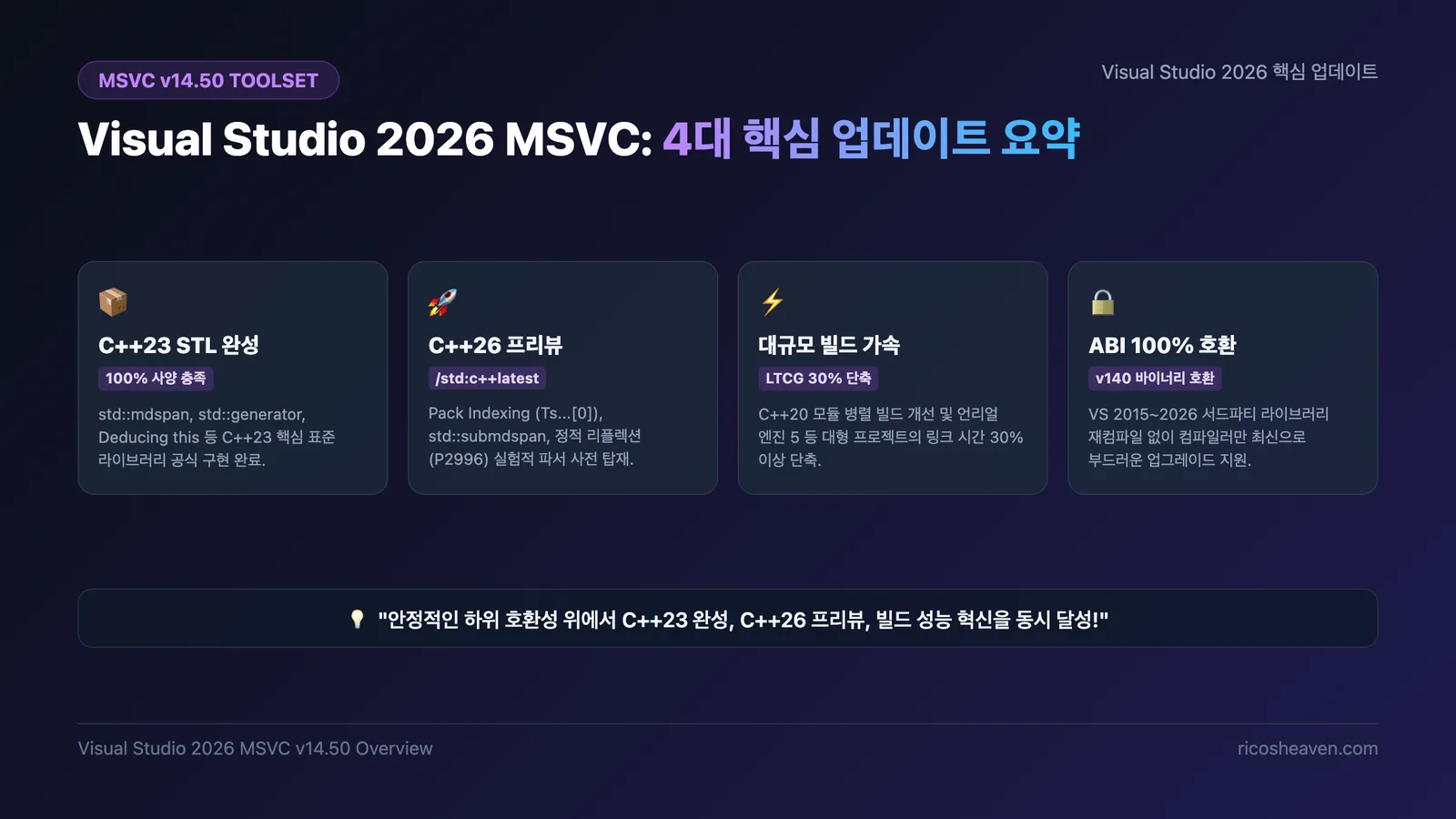
1. Toolset Architecture & 100% ABI Binary Compatibility
A primary concern for C++ developers during compiler upgrades is binary ABI breakage with third-party dependencies.
MSVC v14.50 preserves complete v140 ABI binary compatibility spanning from Visual Studio 2015 through 2026. Developers can upgrade the compiler toolset immediately to leverage modern C++23/C++26 features without recompiling legacy pre-built static libraries (.lib) or dynamic libraries (.dll).
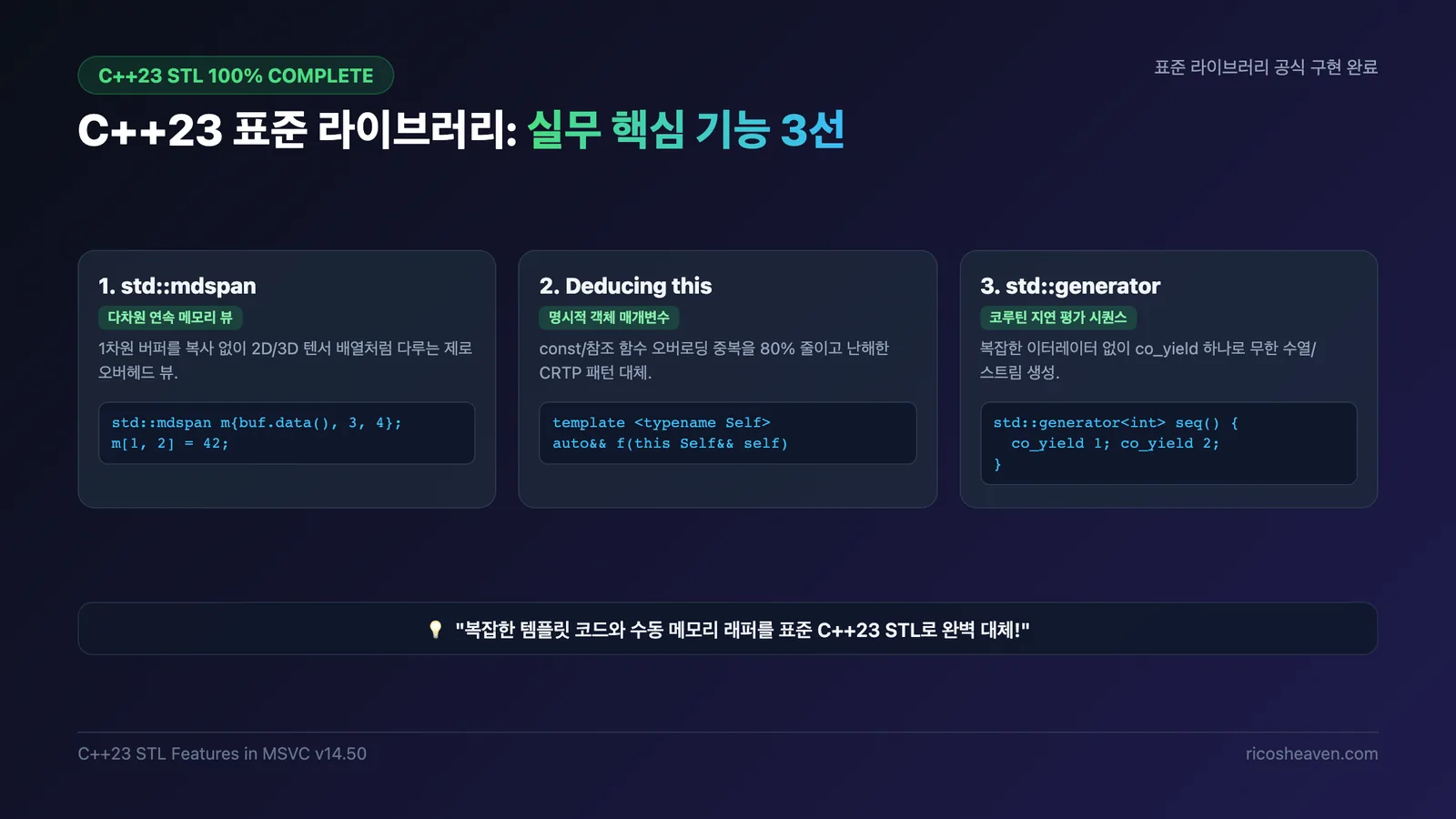
2. 100% C++23 STL Completion: 3 Essential Features
With this release, Microsoft's open-source STL completes all C++23 specifications. Three core additions stand out for production workflows:
1) std::mdspan (Multidimensional Contiguous Memory View)
A zero-overhead multidimensional view over contiguous memory blocks (such as std::vector<float>). It provides intuitive 2D/3D/4D slicing for graphics rendering, linear algebra, and machine learning without data copying:
#include <iostream>
#include <vector>
#include <mdspan>

int main() {
    std::vector<int> buffer(3 * 4); // 12-element contiguous memory

    // Create 3x4 2D zero-copy view
    std::mdspan m{buffer.data(), 3, 4};

    m[1, 2] = 42; // Multidimensional indexing
    std::cout << "m[1, 2] = " << m[1, 2] << "\n";
}
2) Explicit Object Parameter (Deducing this)
Allows member functions to deduce the value and reference category of this via template arguments. This eliminates redundant const/non-const overload boilerplate and cleanly replaces the Curiously Recurring Template Pattern (CRTP):
struct Builder {
    // Automatically deduces const/ref qualifiers for seamless method chaining
    template <typename Self>
    auto&& set_value(this Self&& self, int val) {
        self.value = val;
        return std::forward<Self>(self);
    }
    int value = 0;
};
3) std::generator (Coroutine Lazy Sequence Generator)
Enables lazy evaluation of infinite sequences and data streams using the co_yield keyword, bypassing the need for complex custom iterator boilerplate.
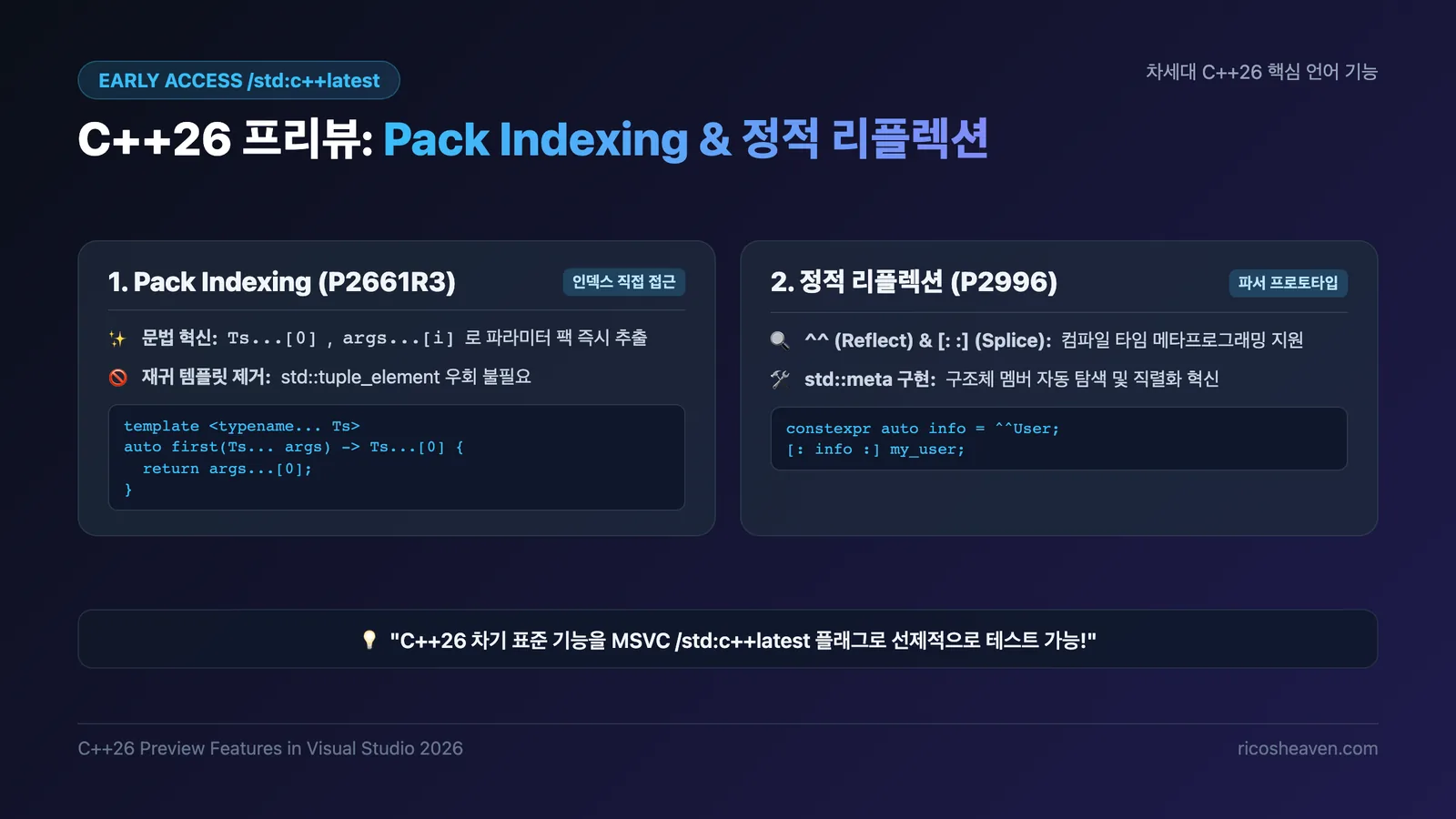
3. C++26 Preview Early Access (/std:c++latest)
Passing the /std:c++latest flag unlocks early access to upcoming C++26 language specifications:
1) Pack Indexing (P2661R3)
Directly indexing into variadic template parameter packs via Ts...[N] and args...[N], eliminating recursive template meta-programming hacks:
// C++26 Pack Indexing: Direct Nth element extraction
template <typename... Ts>
auto get_first(Ts... args) -> Ts...[0] {
    return args...[0];
}
2) Static Reflection (P2996) Experimental Parser
Foundational parser support for the ^^ (Reflect) and [: :] (Splice) operators, alongside early prototyping of the std::meta reflection standard library.

4. Build Throughput Optimization for Massive C++ Codebases
For multimillion-line codebases such as Unreal Engine 5 (UE5) and financial trading architectures, build times directly govern developer iteration cycles. MSVC v14.50 resolves key pipeline bottlenecks:
- Parallel C++20 Module Throughput: Mitigated disk I/O locks and compiler cache contention during Binary Module Interface (BMI) generation, pushing multicore CPU utilization above 90%.
- 30% Faster Link-Time Code Generation (LTCG): Optimized Whole Program Optimization (WPO) duplicate symbol inlining and multithreaded code emission, reducing release link times by over 30%.
- 50% Reduced AddressSanitizer (ASan) Overhead: Improved 64-bit Windows ASan interceptor performance to allow continuous, active memory safety debugging during live game testing.
5. Engineering Conclusion: High Performance Meets Modern C++
Visual Studio 2026 MSVC v14.50 represents a refined balance of rock-solid backward ABI compatibility, complete modern C++23 standards, and decisive build throughput improvements.
- Expressive Modern C++:
std::mdspan, Deducingthis, andPack Indexingeliminate thousands of lines of template boilerplate. - Unmatched Build Velocity: Substantial reductions in link times and module bottlenecks speed up daily iteration loops.
- Forward Looking: Early experimental tooling for C++26 reflection prepares engineering teams for the next decade of C++.
For developers maintaining high-performance C++ applications on Windows, adopting MSVC v14.50 is an essential upgrade.