Saturday, August 22, 2026 — The most groundbreaking paradigm shift currently unfolding in the modern C++ ecosystem is the official tooling adoption of C++26 Static Reflection (P2996).
Following experimental support in GCC 16, JetBrains announced official IDE tooling support for C++26 reflection syntax (^^, [: ... :], and std::meta) across ReSharper C++ 2026.2 and CLion, featuring syntax highlighting, smart code completion, and deep inspection engines.
This monumental feature is set to obsolete decades of macro boilerplate, fragile code generators, and convoluted template metaprogramming tricks. Here is an architectural deep dive into how C++26 static reflection works and how it redefines compile-time serialization.
1. What is Reflection and Why Did C++ Lack It?
Reflection is a language feature allowing a program to introspect its own structure (querying member names, types, functions, and enumerations) and manipulate them programmatically.
Runtime Reflection in Java/C# vs C++ Philosophy
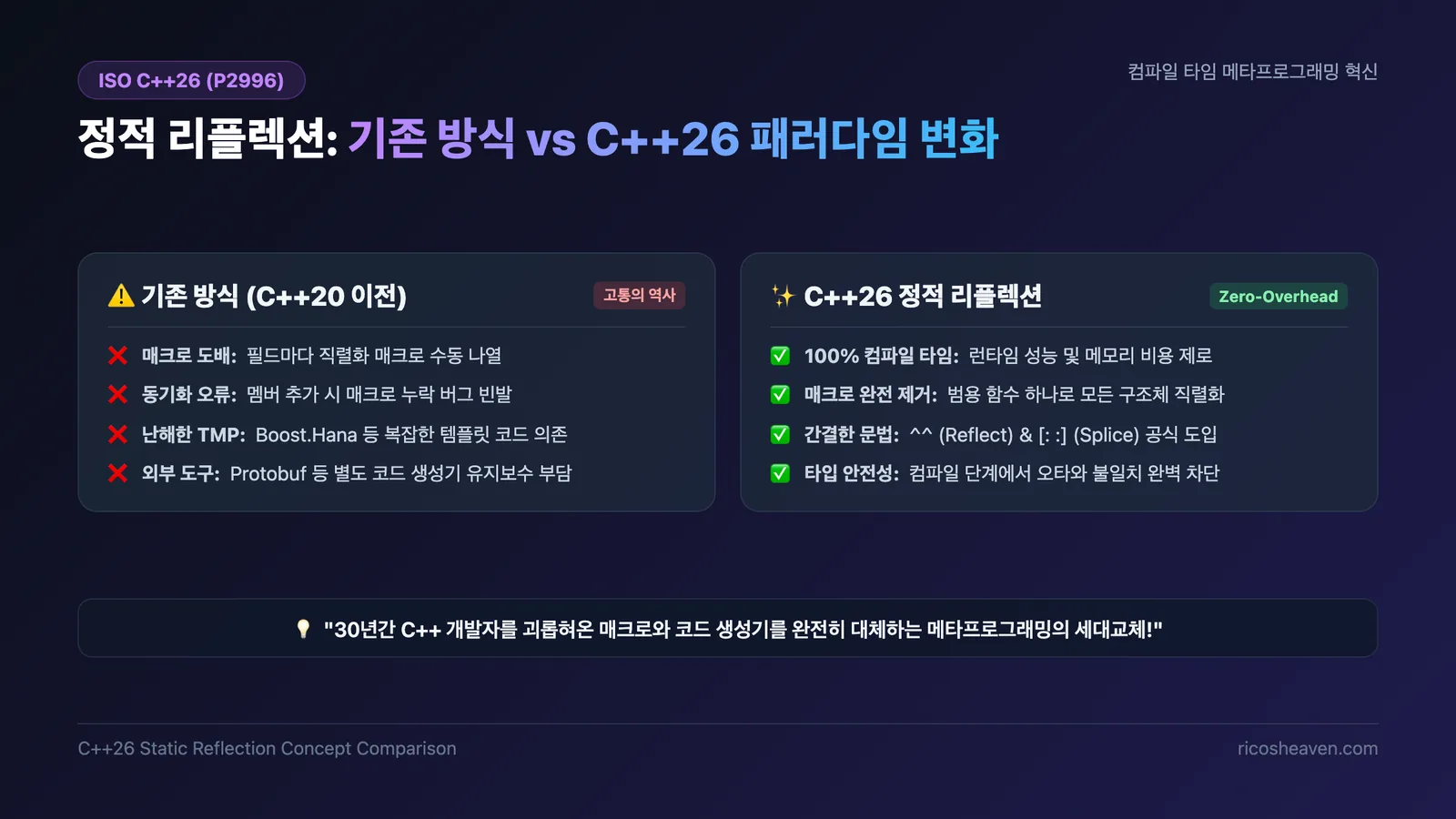
Managed languages like Java, C#, and Python offer dynamic runtime reflection. However, this relies on extensive Runtime Type Information (RTTI) metadata, inflicting memory bloat and execution latency that fundamentally violates C++'s Zero-Overhead Principle ("Don't pay for what you don't use").
Consequently, C++ engineers had to rely on cumbersome workarounds for serialization (JSON/Protobuf), ORM, and Enum-to-string formatting:
- Macro Boilerplate: Explicitly listing every struct field in macros like
NLOHMANN_DEFINE_TYPE_INTRUSIVE, leading to silent bugs whenever a field was added without updating the macro. - External Code Generators: Maintaining separate IDL/schema files (Protobuf, FlatBuffers) in complex build pipelines.
- Arcane Template Metaprogramming (TMP): Relying on complex header-only libraries like
Boost.HanaorBoost.Describe.
The C++26 Solution: Zero-Overhead Compile-Time Reflection (P2996)
C++26 static reflection executes 100% at compile-time. It yields zero runtime overhead, zero RTTI bloat, and fully optimized machine code.
2. The 3 Core Syntax Primitives of C++26 Reflection
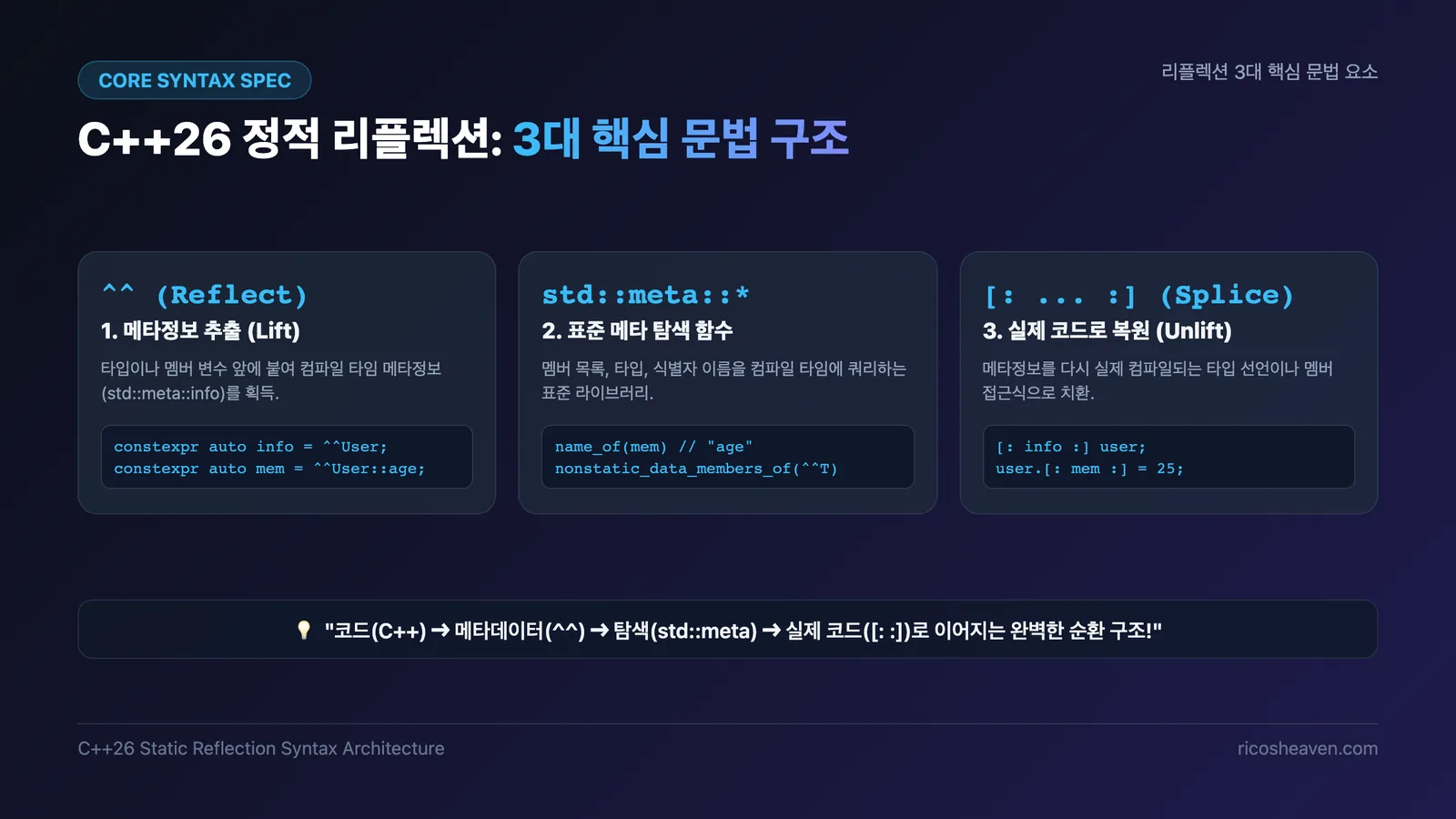
Despite its novelty, C++26 static reflection is built upon three elegant primitives:
1) ^^ (Reflect Operator - Lift)
Prefixing any type, non-static data member, function, or namespace with ^^ produces a compile-time metadata handle of type std::meta::info.
struct Player {
    std::string name;
    int level;
    double hp;
};

// Extract metadata of the struct itself
constexpr std::meta::info type_info = ^^Player;

// Extract metadata of a specific field
constexpr std::meta::info member_info = ^^Player::hp;
2) The std::meta Standard Library
A suite of consteval standard functions designed to inspect and query reflection handles:
std::meta::nonstatic_data_members_of(^^T): Returns a range of member variable reflection handles.std::meta::name_of(info): Returns the identifier name asstd::string_view.std::meta::type_of(info): Returns the reflection handle of the field's data type.std::meta::enumerators_of(^^Enum): Returns all enumerators of an enum.
3) [: ... :] (Splice Operator - Unlift)
Transforms a reflection handle (std::meta::info) back into actual compiled C++ code (a type identifier or member access expression).
Player player{"Rico", 99, 100.0};

// [: type_info :] resolves to the concrete type 'Player'
[: type_info :] new_player;

// player.[: member_info :] resolves to 'player.hp' expression!
player.[: member_info :] = 250.0;
4) template for (Expansion Statement)
A compile-time loop construct that unrolls iterations across reflection ranges during compilation.
3. Practical Innovation: Macro-Free Universal JSON Serialization
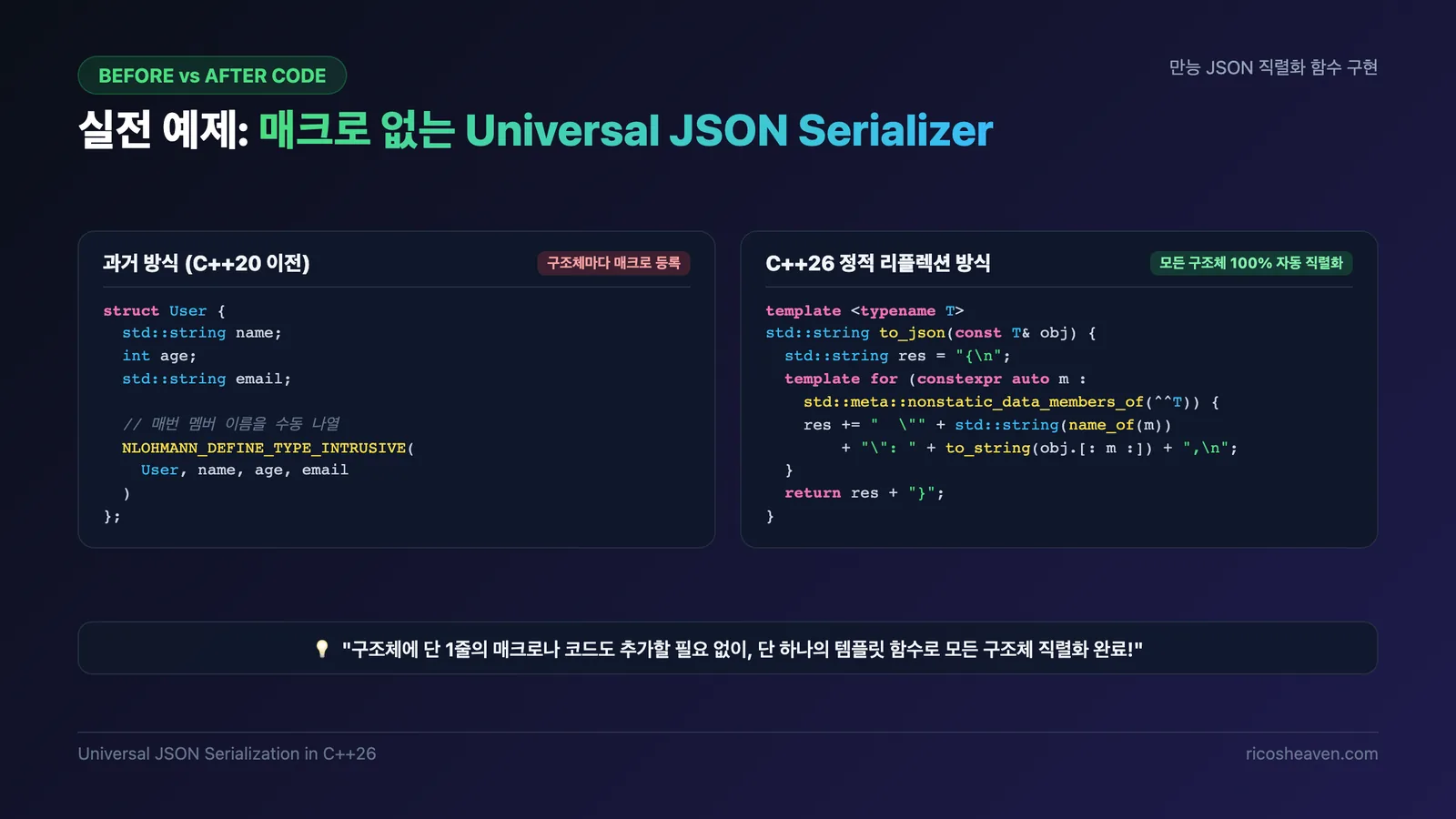
The true power of static reflection becomes apparent when implementing a universal JSON serializer.
C++26 Universal Serializer
A single 10-line generic template function can now serialize any arbitrary struct without adding macros or intrusive hooks to struct declarations:
#include <iostream>
#include <string>
#include <meta>

struct User {
    std::string name;
    int age;
    std::string email;
};

// Universal JSON serializer for any C++ struct
template <typename T>
std::string to_json(const T& obj) {
    std::string json = "{\n";

    // Iterate over all members at compile time
    template for (constexpr auto member : std::meta::nonstatic_data_members_of(^^T)) {
        json += "  \"";
        json += std::meta::name_of(member); // Member name ("name", "age", ...)
        json += "\": ";
        json += std::to_string(obj.[: member :]); // Direct member value access
        json += ",\n";
    }

    json += "}";
    return json;
}

int main() {
    User user{"Rico", 30, "rico@example.com"};
    std::cout << to_json(user) << std::endl;
}
Similarly, Enum-to-String conversions can now be implemented in a few lines of standard C++ without requiring third-party libraries like magic_enum.
4. 2026 Toolchain & IDE Support Ecosystem
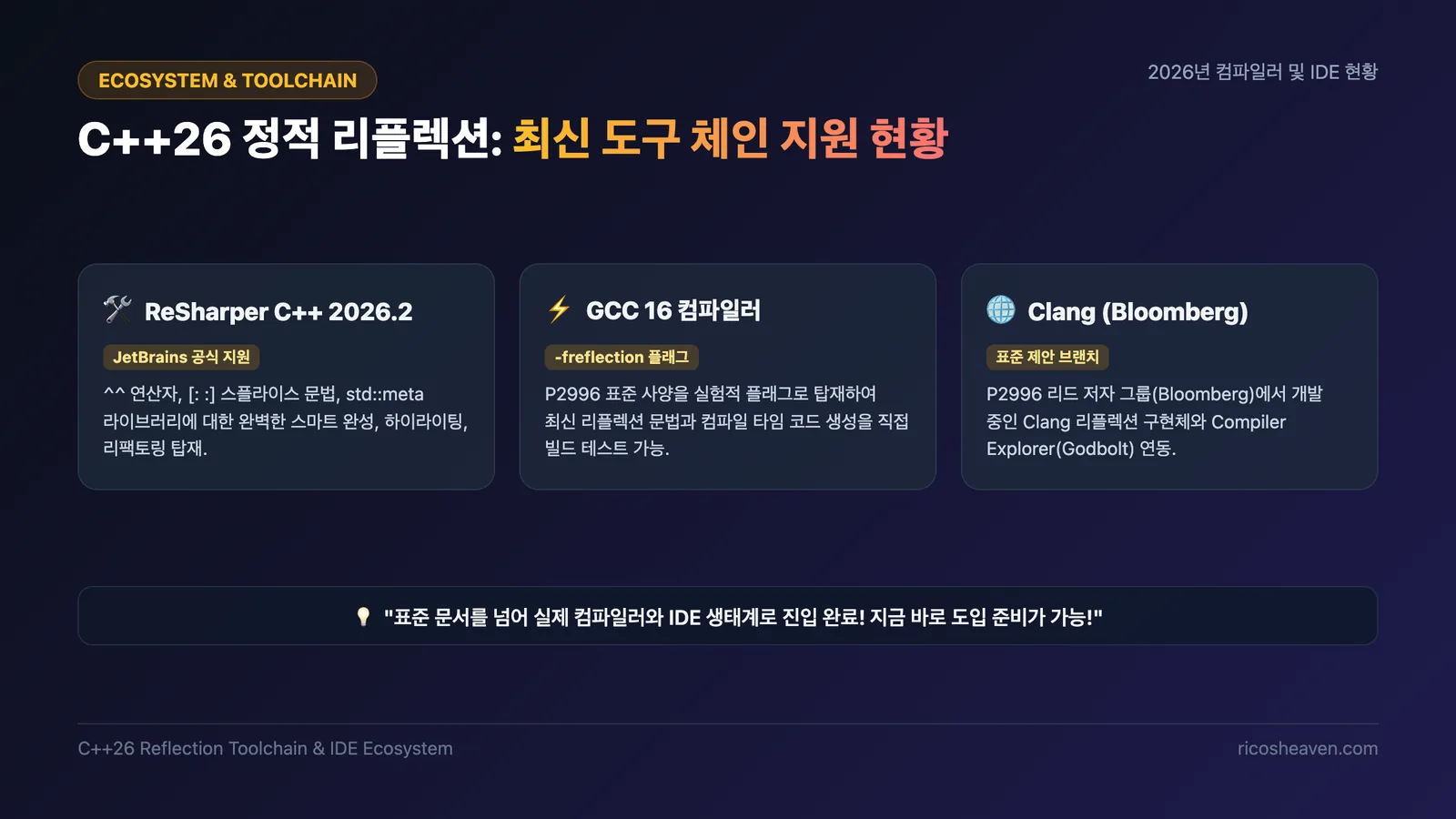
Static reflection is rapidly transitioning from standard committee drafts into production toolchains:
- GCC 16: Implements experimental P2996 static reflection under the
-freflectionflag. - Clang (Bloomberg Fork): Maintained by the core P2996 proposal authors and integrated with Compiler Explorer (Godbolt).
- JetBrains ReSharper C++ 2026.2 & CLion 2026.2: Full syntax parsing, smart completion, and live inspection for
^^,[: :], andstd::meta.
5. Engineering Conclusion: A Generational Metaprogramming Upgrade
C++26 Static Reflection represents the definitive replacement for macros, code generators, and convoluted template metaprogramming tricks that have burdened C++ codebases for decades.
- Pristine Maintainability: Clean separation between data structures and serialization logic.
- Compile-Time Safety: Zero risk of silent omission bugs during field refactoring.
- Zero Runtime Overhead: Perfectly suited for high-frequency trading (HFT), game engines, and low-latency systems.
With GCC 16 and JetBrains IDE tooling leading the way, modern C++ engineers should prepare to embrace static reflection as the new gold standard for meta-engineering in C++26.