Saturday, August 22, 2026 — Watching the rapid evolution of generative AI, I found myself deeply reflecting on a critical question: "Beyond simple coding assistance or writing drafts, can a solo developer or creator realistically build a sustainable revenue pipeline using Claude?"
While the web is flooded with sensationalized 'get-rich-quick AI side hustle' videos, most turn out to be unfeasible or mere clickbait. By analyzing real-world workflows verified by practitioners who have invested substantial capital and time into Claude, I have distilled 5 proven, high-leverage monetization pipelines that deliver real engineering and business value.
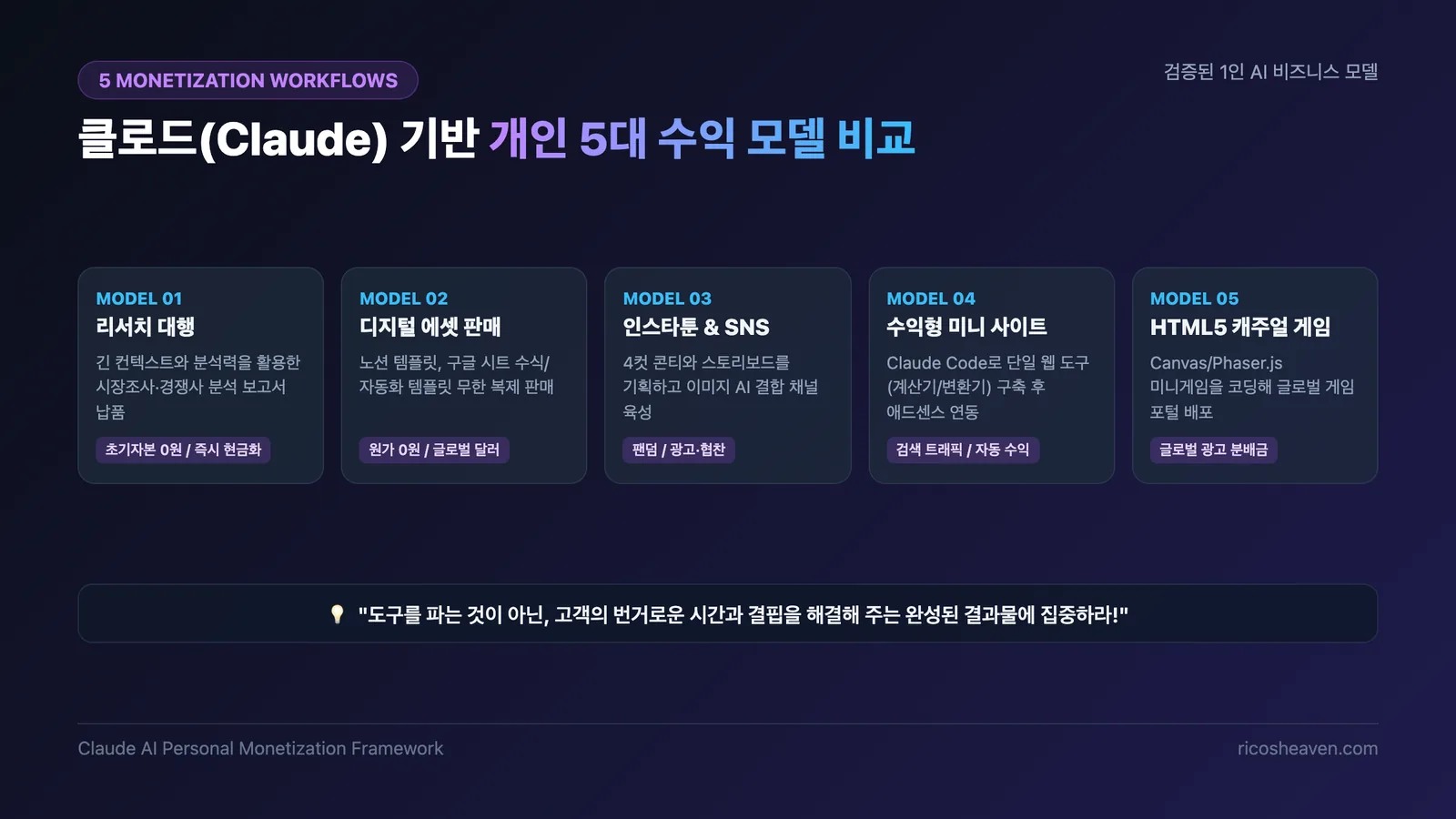
1. Core Principle: Customers Pay for Problem Resolution, Not AI Tools
Before exploring workflows, there is an indisputable rule to keep in mind: Nobody pays for raw AI technology or generic prompts.
Businesses and consumers open their wallets exclusively for two outcomes:
- Drastically saving their valuable time on tedious tasks
- Solving painful problems they cannot easily fix themselves
Claude's expansive 200K token context window and code generation prowess (via Claude Code & Artifacts) reduce the cost of problem-solving to near zero. The competitive edge lies in human verification and packaging that converts raw AI output into tangible business value.
2. Immediate Cash Flow Models (Research Agency & Digital Assets)
For those seeking rapid validation, direct service delivery and reproducible digital assets offer the fastest path to positive cash flow.
Method 1. High-Density Market Research & Data Synthesis (Fastest Cash Flow)
Corporate teams, researchers, and solo entrepreneurs are constantly overwhelmed by market intelligence and competitor benchmarks.
- Execution Pipeline:
- Collect client requirements, global industry reports, and financial PDF filings.
- Upload documents into Claude Projects and execute structured analytical prompts (SWOT matrix, key KPI extraction, comparative data tables).
- Perform thorough human fact-checking and package the insights into polished Notion workspaces or executive slide decks.
- Advantages: Zero upfront capital required, immediate payout upon delivery through freelance marketplaces.
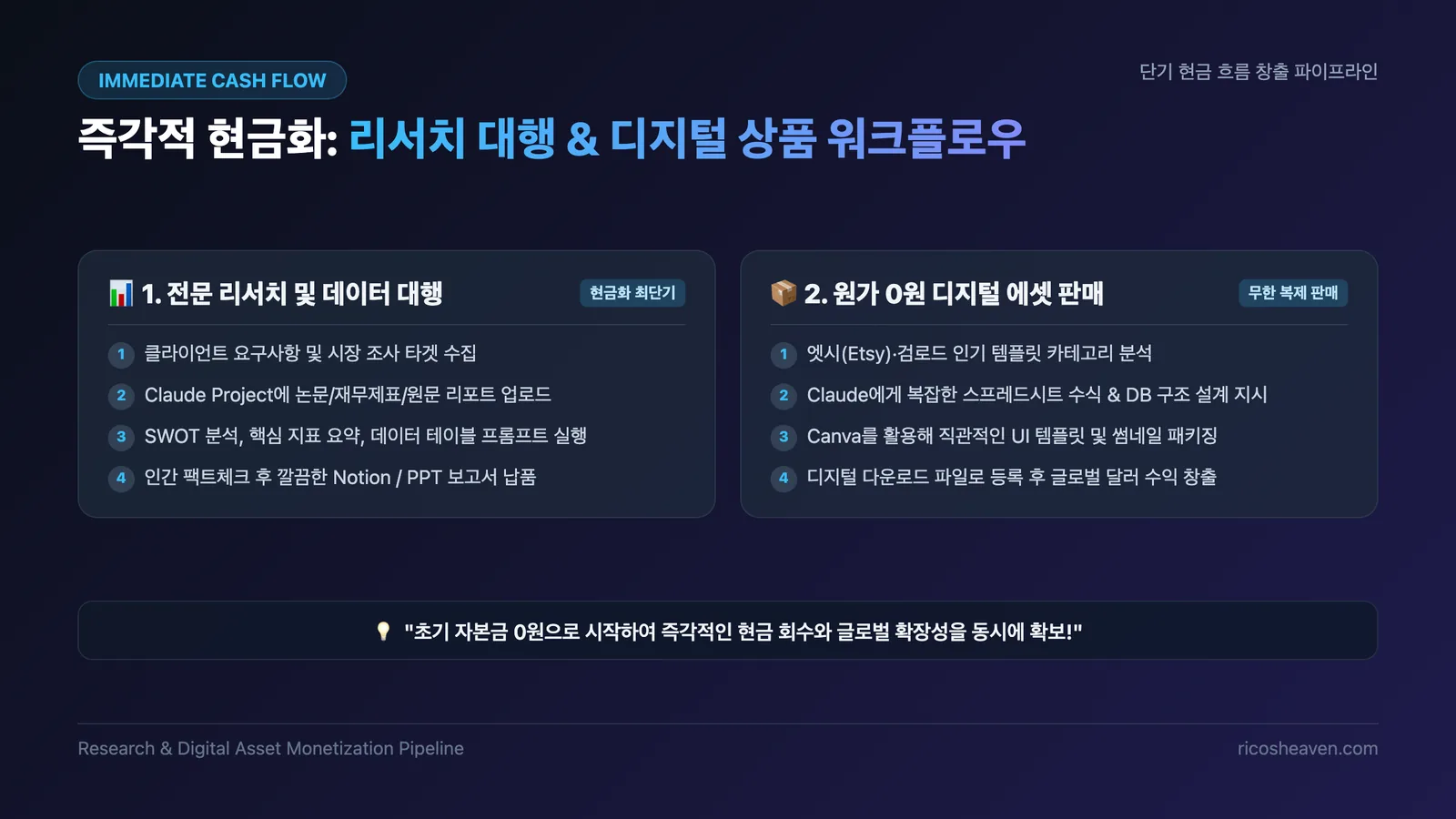
Method 2. Zero-Cost Digital Assets & Template Sales
Digital assets present an infinite inventory business model with zero marginal cost of reproduction.
- Execution Pipeline:
- Identify high-demand categories on Etsy or Gumroad (e.g., smart financial trackers, project dashboards, marketing planners).
- Prompt Claude to architect complex Google Sheets formulas, Apps Script automations, or Notion relational database schemas.
- Apply sleek visual styling via Canva and publish as instant digital download packages.
- Advantages: No physical manufacturing or logistics costs, generating passive international USD revenue.
3. Automated Traffic Assets (Micro Web Apps & HTML5 Games)
Moving beyond one-off service hours, automated software assets leverage search engine traffic and platform distribution to generate recurring advertising and subscription revenue.
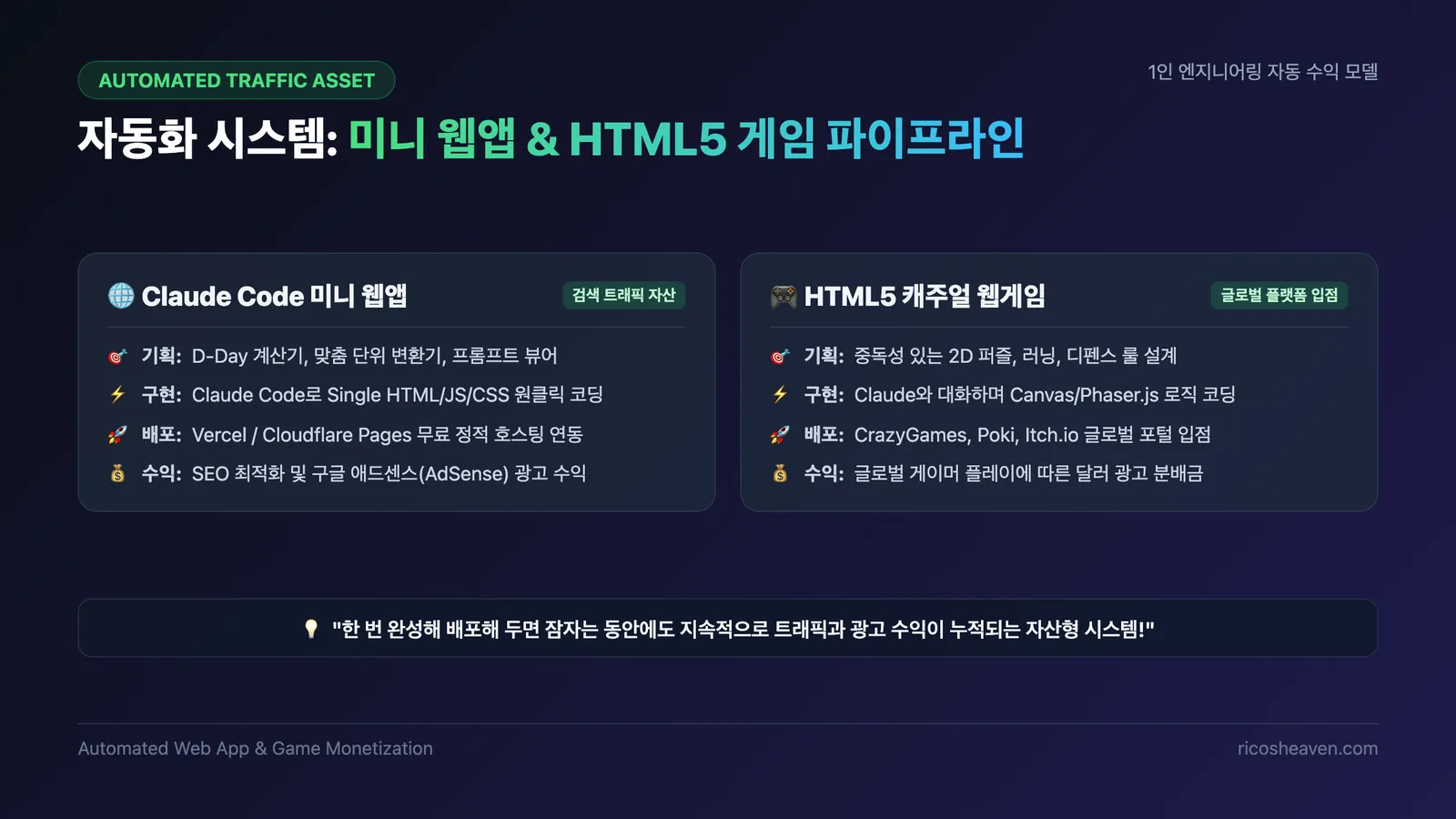
Method 3. Claude Code-Powered Utility Micro-Sites
Modern developers and non-technical creators can build and deploy single-purpose web utilities in just a few hours.
- Execution Pipeline:
- Target long-tail search intent (e.g., specialized deadline calculators, custom unit converters, AI prompt viewers).
- Generate standalone HTML/JS/CSS code using Claude Code or web Artifacts.
- Deploy instantly on free static hosting platforms like Vercel or Cloudflare Pages.
- Optimize on-page SEO and integrate Google AdSense for automated traffic monetization.
Method 4. HTML5 Casual Web Games for Global Portals
Web-based casual gaming platforms (such as CrazyGames, Poki, and Itch.io) continue to experience massive global traffic growth.
- Execution Pipeline:
- Design addictive 2D mechanics (puzzle, runner, or tower defense).
- Iteratively code game loops, collision physics, and score logic with Claude using Canvas or Phaser.js.
- Combine royalty-free commercial game assets and test responsive browser controls.
- Submit to global web game publishers to earn revenue-share disbursements from in-game video ads.
Method 5. Webtoons & Short-Form Storyboard Asset Channels
Even without illustration expertise, creators can deploy Claude as a narrative director to draft episodic 4-panel storyboard scripts, rendering character scenes via AI image tools to scale engaging social media channels for sponsorship deals.
4. Engineering Retrospective & Key Checkpoints
Monetizing AI workflows is not an effortless "money printer." Long-term success requires grounded execution.

1. Human Quality Control (The 80/20 Rule)
Raw AI outputs are commoditized and easily discarded. While Claude accelerates draft generation by 80%, the final 20% of meticulous fact-checking, edge-case handling, and user experience refinement remains strictly human work.
2. Focus on a Single Pipeline
Attempting all five models simultaneously is a recipe for burnout:
- Strong writing & research skills ➔ Research Agency / Digital Templates
- Engineering & automation interest ➔ Micro-Sites / Casual Web Games
- Content strategy & audience building ➔ Webtoons / Short-Form Channels
Selecting one pipeline aligned with your strengths and securing your first dollar of validated revenue is the true catalyst for scalable growth.